An e-commerce store that does not rank organically is entirely dependent on paid advertising to survive. Every sale costs money. The moment the ad spend stops, so does the revenue. eCommerce SEO breaks that dependency, building a compounding stream of organic traffic that grows over time without a cost-per-click attached to every visitor.
But eCommerce SEO is not the same as standard SEO. A store with 5,000 products has 5,000 pages that need to be optimized, internally linked correctly, and kept free from the duplicate content issues that platforms like Shopify and WooCommerce generate automatically. Faceted navigation, product variant URLs, crawl budget management, Google Shopping schema, and out-of-stock page handling are challenges that generalist SEO agencies have never solved for a single client. eCommerce requires specialists.
This guide covers the fourteen agencies that have built genuine eCommerce SEO expertise verified through client results, platform-specific capabilities, and documented technical depth. It also covers what eCommerce SEO costs in 2026, how the four major platforms differ, how AI search is changing product discovery, and what questions to ask before you hire. Whether you run a Shopify DTC brand, a Magento enterprise, or a WooCommerce store ready to scale, this guide will help you find the right partner.
What eCommerce SEO Is and Why It Requires Specialists
eCommerce SEO is the practice of optimizing an online store so that product pages, category pages, and brand content rank organically in search engine results. The goal is not just traffic, it is qualified traffic from people with purchase intent, arriving at product and category pages that convert.
The discipline is technically distinct from national or B2B SEO because the challenges are different. A B2B website has tens of pages to optimize. An eCommerce store has thousands or tens of thousands, with new pages being created constantly as inventory changes. The technical architecture of a product catalog, including how categories are structured, how filters generate URLs, and how product variants are handled, directly determines whether a store can rank at all, regardless of content quality or link authority.
What eCommerce SEO Includes
- Product page optimization: Title tags, meta descriptions, product descriptions, image alt text, and structured data markup for each individual product. For large catalogs, this requires templatized optimization systems rather than manual page-by-page work.
- Category page architecture: Building logical, crawlable category hierarchies that match how users search from broad categories down to specific product types, and ensuring each category page has enough unique content to merit indexation.
- Faceted navigation management: Preventing filter combinations (color, size, price, brand) from generating thousands of near-duplicate URLs that waste crawl budget and create duplicate content penalties. This is the most technically complex challenge in eCommerce SEO.
- Crawl budget optimization: For stores with 10,000+ pages, ensuring Googlebot spends its crawl visits on commercially important product and category pages rather than low-value filter URLs, pagination pages, or search result pages.
- Product schema markup: Implementing Product, Offer, AggregateRating, and Review schema to enable rich results in Google Search star ratings, price, and availability that increase click-through rates from search results pages.
- Google Shopping integration: Optimizing product feed data in Google Merchant Center to align with organic SEO strategy, ensuring product titles, descriptions, and attributes are consistent across organic and Shopping results.
- Out-of-stock and discontinuation handling: Managing product pages for items that go out of stock or are permanently discontinued without losing the ranking signals those pages have accumulated is one of the most commonly mishandled eCommerce SEO challenges.
- Content and topical authority: Building buying guides, comparison content, and category-level editorial content that attracts top-of-funnel traffic and builds the topical authority that makes product pages rank more easily.
- Generative Engine Optimization (GEO): Optimizing product and category content for discovery in AI-powered search tools, such as ChatGPT, Perplexity, and Google AI Overviews, where an increasing share of product research now begins.
Top eCommerce SEO Agencies at a Glance
This table gives you a fast comparison of all fourteen agencies before reading full profiles. Agencies are ordered with Wise Rank leading for UK businesses and comprehensive eCommerce SEO integration.
| # | Agency | Location | Best For | Pricing |
| 1 | Wise Rank | London, UK | UK eCommerce brands: technical + local + platform SEO | Custom |
| 2 | OuterBox | Akron, USA | US enterprise eCommerce — 20+ years platform experience | Custom |
| 3 | Charle Agency | London, UK | Shopify and Shopify Plus specialist — UK and global | Custom |
| 4 | WebFX | Pennsylvania, USA | US mid-market eCommerce with full-service integration | From $2,000/mo |
| 5 | Searchbloom | Salt Lake City, USA | Data-driven eCommerce SEO with A.R.T. methodology | Custom |
| 6 | Coalition Technologies | Los Angeles, USA | eCommerce SEO at scale: Shopify, Magento, BigCommerce | Custom |
| 7 | Victorious | San Francisco, USA | ROI-documented eCommerce SEO for mid to enterprise | From $1,500/mo |
| 8 | Inflow | Denver, USA | Mid-market eCommerce: testing, CRO + organic integration | Custom |
| 9 | No Brainer Agency | Manchester, UK | UK enterprise retailers: SEO + content + digital PR | Custom |
| 10 | Thrive Internet Marketing | Arlington, USA | Full-service eCommerce SEO for multi-channel brands | From $300/mo |
| 11 | Siege Media | Austin, USA | Content-led eCommerce SEO + link building + GEO | Custom |
| 12 | The SEO Works | Sheffield, UK | UK eCommerce SMEs: Google Premier Partner | From £1,500/mo |
| 13 | Impressive | Melbourne, AUS | APAC eCommerce brands: revenue-focused organic SEO | Custom |
| 14 | Sure Oak | New York, USA | Authority-building for eCommerce brands with strong tech | Custom |
Top eCommerce SEO Agencies: Full Profiles
1. Wise Rank
| URL: wiserank.co.uk Location: London, UK (serves globally) Best for: UK eCommerce brands needing technical eCommerce SEO fully integrated with platform expertise, local search signals, and GEO readiness Pricing: Custom — contact for quote |
Wise Rank leads this list for UK eCommerce brands because of a capability combination that most eCommerce SEO agencies do not offer: the integration of technical eCommerce SEO, platform-specific optimization, and local search performance in a single coordinated service. UK online retailers, particularly those operating in verticals like home goods, fashion, health and beauty, and trade supplies, need all three working together. Technical fixes that ignore local intent fail. Local SEO that sits on a technically broken eCommerce platform produces no results. Wise Rank addresses the full stack.
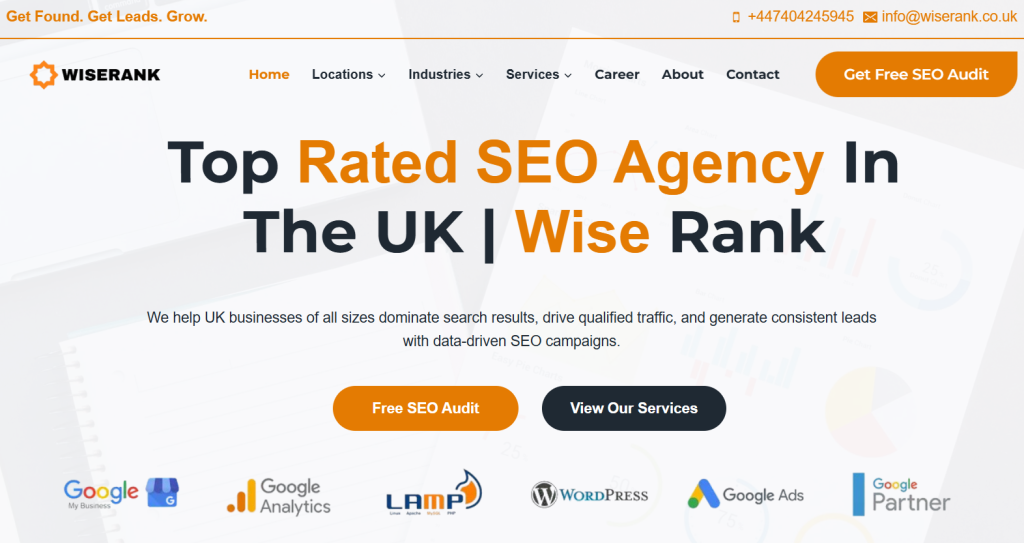
Their eCommerce SEO practice covers the technical challenges that define whether large product catalogs can rank at all: faceted navigation canonicalization, crawl budget optimization for large SKU counts, product variant duplicate content resolution, out-of-stock page handling strategies, and Product schema implementation for rich result eligibility. These are the issues that separate genuine eCommerce SEO specialists from agencies that apply generic SEO playbooks to online stores.
For UK eCommerce businesses, Wise Rank’s geographic depth across British markets adds direct commercial value. Their work across city-specific landing pages, local schema implementation, and UK-specific citation management means that product and category pages are optimized not just for national search queries but for the high-intent local queries that drive in-store pickup requests, local delivery orders, and click-and-collect conversions. This integration is particularly valuable for UK retailers operating physical locations alongside their eCommerce operations.
Their approach to Generative Engine Optimization reflects an understanding that AI-powered product discovery is no longer theoretical in the UK market. Google AI Overviews appear in product research queries. ChatGPT is used by consumers to compare products before purchase. Wise Rank’s structured content implementation schema markup, FAQ content, comparison-ready product descriptions ensure client products are positioned for AI citation as well as traditional SERP rankings.
| Limitation: Wise Rank’s primary market expertise is the UK. eCommerce brands with US-centric or APAC-primary operations may benefit from combining their technical eCommerce SEO work with agencies that have deeper regional expertise in those markets. |
2. OuterBox
| URL: outerboxdesign.com Location: Akron, Ohio, USA Best for: US enterprise and mid-market eCommerce brands needing platform-specialist SEO across Shopify, BigCommerce, Magento, and WooCommerce Pricing: Custom — typically mid to high four figures monthly |
OuterBox has been exclusively focused on eCommerce SEO since 2004, longer than most of their competitors have been operating at all. Their 240-person in-house team has influenced over two billion dollars in client online sales across 1,200+ eCommerce clients, giving them a pattern-recognition advantage that comes only from solving the same technical eCommerce challenges across hundreds of different stores, platforms, and verticals.
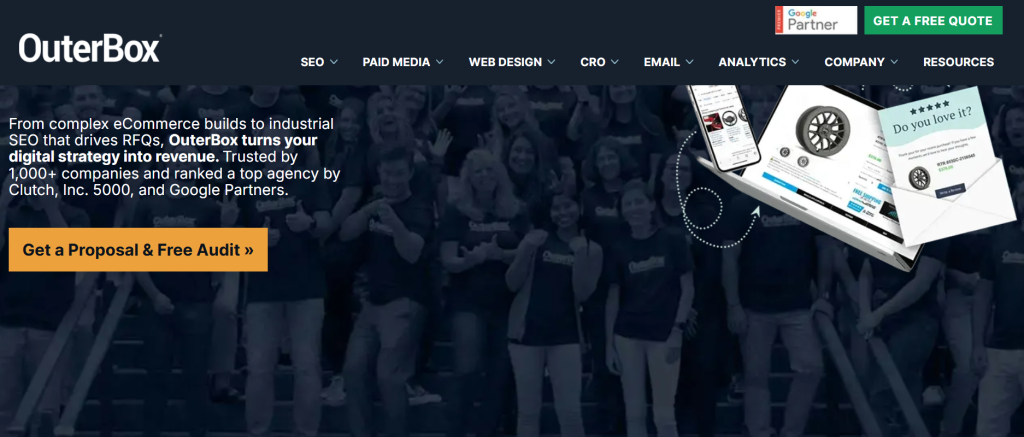
Their platform depth is genuine: they have published documented processes for Shopify canonical tag management, BigCommerce category content optimization, Magento faceted navigation configuration, and WooCommerce performance optimization. Their methodology is not adapted from generic SEO; it was built specifically for e-commerce from the start. This matters because eCommerce SEO failures are almost always caused by agencies applying standard SEO logic to technical problems that require platform-specific solutions.
OuterBox expanded into Generative Engine Optimization and AI SEO — implementing structured content strategies that position product pages for discovery in ChatGPT, Perplexity, Google AI Overviews, and Gemini. Their full-service model covers SEO, PPC, CRO, web design, and eCommerce development in a single agency relationship, which eliminates the coordination friction that occurs when separate agencies manage separate channels for the same store.
| Limitation: OuterBox is entirely US-focused. UK and European eCommerce brands will find their case studies, team, and market expertise calibrated for the American eCommerce environment. International clients may need regional specialists alongside their work. |
3. Charle Agency
| URL: charleagency.com Location: London, UK (serves globally) Best for: Shopify and Shopify Plus eCommerce brands in the UK and globally, needing platform-certified SEO integrated with design and conversion optimization Pricing: Custom |
Charle Agency is a Shopify-certified partner with documented specialization in the specific SEO challenges the Shopify platform creates. Their team understands Shopify’s enforced URL structure, how to configure canonical tags correctly through the theme layer, how to manage the duplicate content issues created when products appear in multiple collections, and how to implement Product schema through Shopify’s metafield system rather than app-based workarounds that create technical debt.
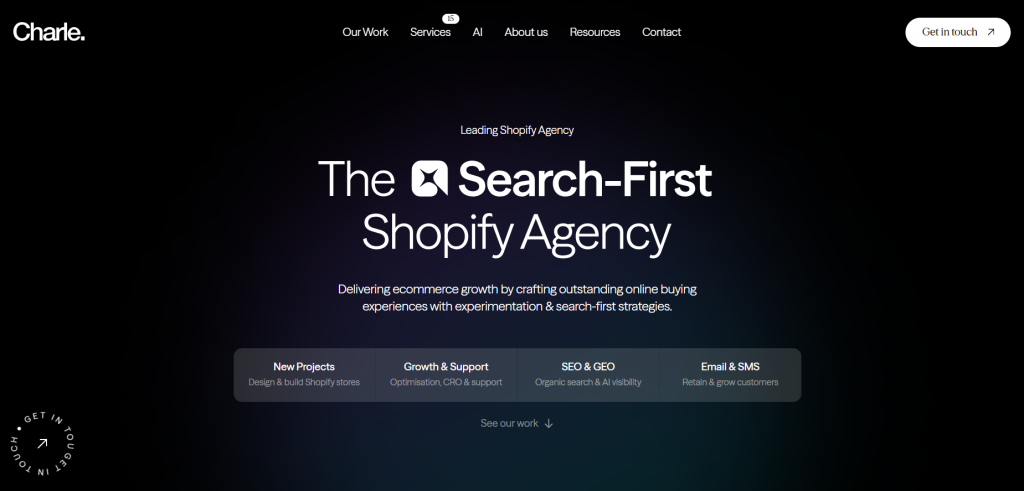
Their service integrates eCommerce SEO with Shopify-specific design and conversion optimization, a combination that matters for organic search performance because Google’s Core Web Vitals assessments and user engagement signals are directly affected by page design and load performance. A Shopify store with strong organic rankings but poor conversion rates wastes the traffic it earns. Charles’s integrated model addresses both organic visibility and on-site conversion simultaneously.
For UK Shopify brands specifically, Charles ‘ market knowledge means their keyword research reflects UK search behavior, their content recommendations align with UK buyer intent, and their technical implementations are tested against UK network conditions and device usage patterns. UK eCommerce clients working with US-based Shopify agencies often find that strategy recommendations designed for the American market do not translate directly to UK consumer behavior.
| Limitation: Charles Agency’s specialization is Shopify and Shopify Plus. eCommerce businesses on Magento, WooCommerce, or BigCommerce will find their platform-specific expertise less directly applicable. |
4. WebFX
| URL: webfx.com Location: Harrisburg, Pennsylvania, USA (serves globally) Best for: US mid-market and enterprise eCommerce businesses needing eCommerce SEO integrated with paid media, content, and revenue attribution technology Pricing: From approximately $2,000/month |
WebFX has generated over ten billion dollars in client revenue according to their published figures, with MarketingCloudFX and RevenueCloudFX proprietary platforms tracking every keyword, click, and conversion across organic and paid channels simultaneously. For eCommerce brands, the attribution question — which channel drove this sale? — is central to budget allocation decisions, this technology layer provides answers that most agencies cannot deliver.
Their eCommerce SEO work covers the full technical and content stack: product page optimization, category architecture, faceted navigation management, schema markup, Core Web Vitals optimization, and link acquisition. Their team size of several hundred employees allows them to service large eCommerce catalogs at a pace that boutique agencies cannot match, which matters when a store with 10,000 products needs systematic product page optimization rather than selective optimization of priority items.
The integration between eCommerce SEO and paid search is where WebFX creates specific value: their proprietary tooling identifies keywords where organic and paid campaigns are cannibalizing each other, and reallocates budget toward the channel with better cost efficiency per conversion. For growing eCommerce brands spending simultaneously on Google Shopping and SEO, that coordination reduces wasted spend.
| Limitation: WebFX’s scale means individual client relationships are managed through account teams rather than direct access to senior specialists. For eCommerce brands with complex technical challenges requiring close senior attention, boutique specialists may deliver more focused engagement. |
5. Searchbloom
| URL: searchbloom.com Location: Salt Lake City, Utah, USA Best for: US eCommerce brands that want organic and paid search treated as a unified acquisition strategy rather than separate budget lines Pricing: Custom — typically $1,500 to $3,500/month |
Searchbloom’s A.R.T. framework — Authority, Relevance, Technology — approaches eCommerce SEO as a component of a complete search acquisition strategy rather than an isolated channel. Their model prevents the keyword cannibalization problem that occurs when paid search and organic SEO teams optimize independently: an eCommerce brand bidding on Google Shopping for keywords where it already ranks organically in position one is paying for traffic it should receive for free.
Their site architecture diagnostics specifically target the crawl efficiency problems that limit product discoverability as eCommerce catalogs grow — faceted navigation generating duplicate URLs, internal linking structures that fail to channel authority from category pages to product pages, and indexation bloat from search result pages and tag archives being accidentally exposed to crawl. These are the issues that quietly suppress rankings across entire categories of products while the store owner focuses on content and links.
Searchbloom’s technical foundation work begins before any content or link strategy is applied — auditing crawl efficiency, fixing indexation problems, and implementing proper schema before building on top of a broken architecture. This sequencing produces more durable results than agencies that apply content and links to sites with unresolved technical problems.
| Limitation: Searchbloom is US-focused. Their integrated paid and organic model is most valuable for brands actively running Google Shopping and Google Ads alongside SEO — eCommerce brands that are purely organic will not benefit from the full value of their combined methodology. |
6. Coalition Technologies
| URL: coalitiontechnologies.com Location: Los Angeles, California, USA Best for: eCommerce brands at scale needing systematic product page optimization across thousands of pages on Shopify, Magento, BigCommerce, or WooCommerce Pricing: Custom — typically from $1,500/month |
Coalition Technologies has been operating in eCommerce SEO since 2009 and has built systematic product page optimization processes for large catalogs — the specific capability that separates agencies that have worked with enterprise eCommerce from those who have not. When a store has 3,000 product pages that need unique title tags, meta descriptions, on-page content, and schema markup, you need process infrastructure. Coalition has built that infrastructure across fifteen years of large-catalog eCommerce work.
Their platform coverage spans Shopify, BigCommerce, Magento, and WooCommerce, with documented case studies across retail, fashion, health and beauty, home goods, and industrial supply verticals. Their design team works alongside their SEO team, which means product page UX improvements — better image presentation, cleaner product descriptions, improved internal linking — can be implemented alongside technical SEO fixes without requiring a separate design agency engagement.
Their top 1% hiring standard across their team means technical recommendations are consistently accurate rather than occasionally experimental. Their research depth on client projects — keyword gap analysis, competitor catalog auditing, category opportunity mapping — reflects a team that has solved eCommerce SEO problems at real scale, not just in small-catalog pilot projects.
| Limitation: Coalition Technologies is a premium US-based agency. UK and international eCommerce brands will find their geographic market experience calibrated for the American retail environment. Team size can mean variable senior attention depending on the account tier. |
7. Victorious
| URL: victorious.com Location: San Francisco, California, USA Best for: Mid-market to enterprise eCommerce brands that need detailed ROI documentation and transparent performance reporting for internal stakeholders Pricing: From approximately $1,500/month |
Victorious has won over 180 industry awards and produced documented results, including a 1,122% increase in page-one keywords and 214% growth in monthly revenue for Lychee the Label, an emerging women’s streetwear brand. Their eCommerce SEO practice covers Shopify, Magento, WooCommerce, and BigCommerce, with a methodology that combines keyword strategy, anchor text analysis, technical site audit, featured snippet optimization, schema optimization, and EEAT-aligned content development.
Their reporting culture is their strongest differentiator. For eCommerce brands where the CMO or eCommerce director needs to present organic search ROI to leadership, Victorious structures reporting around revenue contribution, not keyword rankings. Before/after metrics are documented with sufficient specificity to attribute revenue movements to specific SEO interventions a level of commercial accountability that most eCommerce SEO agencies do not provide.
Their compound visibility model applies entity development, content strategy, and technical SEO simultaneously, treating eCommerce SEO not as a series of isolated optimizations but as a coordinated program designed to build topical authority across product categories, which compounds into progressively stronger rankings as category pages and product pages reinforce each other through structured internal linking.
| Limitation: Victorious’s minimum investment thresholds make it inaccessible for very small eCommerce stores. Their methodology is designed for brands with enough organic search potential to justify mid-market agency investment. |
8. Inflow
| URL: goinflow.com Location: Denver, Colorado, USA Best for: Mid-market to enterprise US eCommerce brands that want SEO and CRO integrated — testing organic hypotheses against conversion data before scaling Pricing: Custom |
Inflow’s distinctive approach to eCommerce SEO is their experimental methodology: they treat organic search optimization as a series of testable hypotheses rather than a set of best practices applied uniformly. Changes to product page templates, category structures, or internal linking patterns are tested against conversion data before being applied at scale, preventing the common failure mode where an SEO recommendation improves rankings but reduces conversion rates.
Their analytics setup is advanced: GA4 configuration for eCommerce, Search Console integration, and attribution modeling that separates organic-traffic conversions by category, product type, and user intent stage. This reporting foundation means every organic search initiative can be evaluated not just by rankings and traffic but by its contribution to organic revenue and conversion rate across product categories.
Their client base skews toward mid-market and enterprise US eCommerce brands, particularly in fashion, outdoor, sports, and consumer goods, where the complexity of the catalog and the competitive intensity of organic search justify a rigorous, data-driven SEO approach rather than a templated monthly deliverable.
| Limitation: Inflow is a US-only agency. Their experimental methodology requires clients who are comfortable with a testing-oriented engagement rather than a fixed-deliverable retainer. Brands expecting rapid early results from an eCommerce SEO engagement may need to recalibrate expectations. |
9. No Brainer Agency
| URL: nobraineragency.com Location: Manchester, UK Best for: UK enterprise retailers with large catalogs needing eCommerce SEO integrated with content marketing and digital PR for authority building Pricing: Custom |
No Brainer Agency is a B Corp-certified UK agency focused specifically on enterprise eCommerce retailers, brands with tens of thousands of SKUs, large-scale content catalogues, and multi-brand portfolio structures. Their service integrates eCommerce SEO, content marketing, and digital PR into a unified organic performance program, reflecting an understanding that large UK retailers compete for rankings across both product queries and editorial queries simultaneously.
Their proprietary Navigator tool provides revenue forecasting before optimization begins, showing eCommerce clients where organic growth will come from in commercial terms before any SEO work is committed to. For enterprise retail marketing directors who need to justify SEO investment to finance leadership, this revenue model provides the commercial framing that standard keyword opportunity analyses do not.
They have won UK Search Awards across multiple years and serve clients including AO.com, one of the UK’s leading online electrical retailers, which reflects genuine enterprise eCommerce SEO capability rather than mid-market positioning. Their team understands the specific challenges of large UK retail catalogs: product variant management, seasonal inventory cycling, brand page optimization for major manufacturer relationships, and category restructuring without loss of accumulated ranking equity.
| Limitation: No Brainer Agency is positioned for enterprise UK retailers. Smaller eCommerce businesses or international brands outside the UK retail market will find their specialization less directly applicable to their situation. |
10. Thrive Internet Marketing Agency
| URL: thriveagency.com Location: Arlington, Texas, USA (multiple offices) Best for: Multi-channel US eCommerce brands needing eCommerce SEO coordinated alongside PPC, social media, and email marketing in a single agency. Pricing: From approximately $300/month; enterprise custom |
Thrive is one of the most accessible full-service digital marketing agencies for eCommerce brands in the United States, with transparent entry pricing and a structured retainer model that covers SEO, PPC, social media, email marketing, and web design. For growing eCommerce brands that cannot yet separate channel management across multiple specialist agencies, Thrive’s bundled model reduces coordination overhead significantly.
Their eCommerce SEO work covers technical audits, product page optimization, category architecture, schema markup implementation, and link building, delivered alongside Google Shopping campaign management and paid social advertising. The integration between organic and paid eCommerce channels means technical SEO improvements are immediately tested under paid traffic conditions, revealing conversion problems before organic traffic scales into them.
Their intake process provides realistic budget guidance, monthly retainer bands from $2,500 to $5,000 and above, with a clear scope attached to each tier, which makes investment planning straightforward for eCommerce brands that have been frustrated by agencies that quote custom proposals without any public pricing reference points.
| Limitation: Thrive’s broad service scope means eCommerce SEO is one of many capabilities rather than a primary specialization. Brands with complex technical eCommerce challenges or large catalog management needs may find that a specialist eCommerce SEO agency delivers deeper technical expertise. |
11. Siege Media
| URL: siegemedia.com Location: Austin, San Diego, New York, USA Best for: Content-led eCommerce brands needing buying guides, comparison content, and editorial authority combined with technical SEO and link building Pricing: Custom |
Siege Media has appeared on the Inc. 5000 list six consecutive times and built their eCommerce SEO reputation on a specific model: premium content that earns editorial links from authoritative publishers, combined with technical SEO that ensures product and category pages benefit from the authority that content earns. For eCommerce brands in verticals where buying guides, product comparison content, and editorial reviews drive top-of-funnel traffic, this content-led model builds compounding organic authority.
Their product-led approach integrates technical SEO health with content strategy — fixing crawl and indexation issues that prevent content from ranking, then building the content structures that channel authority to product and category pages. They also integrate GEO into their eCommerce SEO work, ensuring that editorial content and product pages are structured for AI citation in ChatGPT and Perplexity as well as traditional SERP rankings.
For eCommerce brands that have a solid technical foundation but lack the content depth to compete for high-value informational and comparison queries, Siege Media fills that gap specifically. Their content production quality — professional research, proper editorial standards, visual assets — earns links from the kind of publications that improve both traditional rankings and AI search visibility.
| Limitation: Siege Media is content-first. Brands with significant unresolved technical eCommerce SEO problems — faceted navigation issues, crawl budget waste, product variant duplicate content — should address those foundations with a technical specialist before engaging Siege for content-led authority building. |
12. The SEO Works
| URL: seoworks.co.uk Location: Sheffield, UK (serves globally) Best for: UK eCommerce SMEs and mid-market brands needing rigorous technical eCommerce SEO at accessible pricing with Google Premier Partner credibility Pricing: From approximately £1,500/month |
The SEO Works holds Google Premier Partner status — awarded to the top 3% of Google Partners globally — and has built a significant eCommerce SEO practice serving UK retailers across fashion, health and beauty, home goods, and specialist retail verticals. Their eCommerce case studies show organic revenue improvements across Shopify and WooCommerce clients in competitive UK product categories.
Their technical eCommerce SEO capability covers faceted navigation management, product schema implementation, crawl efficiency improvements, Core Web Vitals optimization, and category content strategy. Their audit-first methodology ensures technical problems are identified and prioritized by revenue impact before content or link work begins — preventing the common mistake of building content on top of unresolved technical foundations.
For UK eCommerce brands that want mid-market agency rigor — more specialist depth than a generalist digital agency, more accessible pricing than the enterprise boutiques — The SEO Works provides a practical option. Their Google Premier Partner status provides independent credibility, and their UK market focus means their recommendations are calibrated for British consumer search behavior rather than imported from US market research.
| Limitation: Their sweet spot is UK mid-market eCommerce. Very large enterprise catalogs with complex Magento architectures or multi-language international deployments may require the deeper specialist capability that pure-play enterprise eCommerce agencies provide. |
13. Impressive
| URL: impressivedigital.com Location: Melbourne, Australia (serves globally) Best for: APAC eCommerce brands and global retailers needing revenue-first organic SEO tied explicitly to conversion metrics and business growth Pricing: Custom |
Impressive brings an explicitly revenue-first approach to eCommerce SEO: every engagement begins with ROI projections that model the expected organic revenue impact before work begins, and every monthly report attributes organic traffic to revenue rather than stopping at rankings or sessions as the primary measure. For e-commerce leadership teams who have been burned by SEO agencies that produced traffic without sales, this commercial accountability framework changes the nature of the agency relationship.
Their documented work with Top Fitness, an Australian fitness equipment retailer, demonstrates their mid-funnel SEO capability: rather than chasing top-of-funnel keyword volume, they identified high-intent comparison and category queries at the mid-buyer journey that the client had been missing, and built content strategies around those queries specifically. The result was 26.66% year-over-year organic revenue growth from a strategic shift rather than simply more content.
Their platform expertise spans Shopify, WordPress, WooCommerce, and Adobe Commerce, with technical audit processes adapted for each platform’s specific SEO constraints. For APAC eCommerce brands that have historically worked with US or UK agencies without regional market understanding, Impressive’s Australian base and Asia-Pacific market knowledge provide a geographic relevance that matters for local search signals, regional citation management, and content calibrated for regional consumer behavior.
| Limitation: Impressive is primarily an APAC agency. UK and US eCommerce brands working with them should expect engagement management across significant time zone differences, which can affect communication cadence and response time on time-sensitive technical issues. |
14. Sure Oak
| URL: sureoak.com Location: New York, USA Best for: eCommerce brands with a strong technical foundation that need authority-building link acquisition, content strategy, and topical depth to break into competitive product categories Pricing: Custom |
Sure Oak is positioned for the specific eCommerce SEO situation where technical health is adequate, but domain authority is the bottleneck: stores that have resolved crawl errors, implemented schema, and optimized product pages, but still cannot break into the top positions for competitive category-level keywords because their link profile is insufficient relative to established competitors.
Their proprietary link acquisition methodology emphasizes editorial quality over volume — building links from authoritative publishers, industry directories, and relevant media rather than link farm patterns that create short-term ranking improvements followed by algorithmic penalties. For eCommerce brands in competitive verticals like supplements, fashion, consumer electronics, or sporting goods, where top-ranking competitors have accumulated significant link authority over the years, this quality-first approach is necessary for sustainable competitive ranking.
Their content strategy work builds the topical authority that makes product and category pages rank more easily over time. Buying guides, product comparison content, and category-level editorial content create a content ecosystem that earns links naturally, improves site-wide topical relevance, and positions the store as an authoritative destination in its vertical rather than a thin product catalog.
| Limitation: Sure Oak is most valuable when technical foundations are already in place. eCommerce brands with significant unresolved technical issues — faceted navigation problems, crawl budget waste, poor product schema — should address those first with a technical specialist before investing in authority building. |
How Much Does eCommerce SEO Cost?
Pricing transparency is rare in the e-commerce SEO market. Most agencies quote custom rates, making it difficult to budget without going through a full sales process. The ranges below reflect current market rates based on published pricing, agency-disclosed ranges, and client-reported costs across the industry.
| Store Profile | Typical Monthly Range | What Is Included | Key Variable |
| Small store: under 500 SKUs | $500 — $1,500/mo | Technical audit, product page optimization, schema, basic content | Platform complexity and vertical competition level |
| Mid-market: 500 — 5,000 SKUs | $1,500 — $4,000/mo | Full technical SEO, category strategy, content, link building, schema | Catalog architecture complexity and competitive category count |
| Large catalog: 5,000 — 50,000 SKUs | $4,000 — $10,000/mo | Crawl budget management, templatized optimization, faceted nav, GEO | Faceted navigation complexity and international scope |
| Enterprise: 50,000+ SKUs | $10,000 — $25,000+/mo | Full platform engineering support, log file analysis, multi-region | Multi-brand portfolio, international hreflang, Magento complexity |
| Shopify DTC brand (growth stage) | $1,500 — $3,500/mo | Shopify-specific technical fixes, collection SEO, content, links | Product variant count and collection hierarchy depth |
| eCommerce SEO audit (one-time) | $1,000 — $5,000 | Technical audit, crawl analysis, competitor gap analysis, roadmap | Store size and platform — larger catalogs require deeper auditing |
Be cautious of e-commerce SEO agencies offering comprehensive services below $500 per month. At that price point, automated tools replace human analysis, and the eCommerce-specific technical work, faceted navigation management, crawl budget optimization, and product schema validation, is simply not being done. The agencies that produce real organic revenue growth for eCommerce stores spend meaningful time each month on technically complex, catalog-specific work that cannot be automated.
GEO and AI Search: How eCommerce SEO Is Changing
Product discovery is no longer confined to Google Search. A growing share of eCommerce product research in 2026 begins in AI-powered tools, such as ChatGPT, Perplexity, and Google AI Overviews. When someone asks ChatGPT What is the best running shoe for flat feet under £100,’ they receive a product recommendation with brand names, not a list of links to optimize through. The brands that appear in those recommendations have either been cited in content that AI systems have indexed or have implemented the structured signals that make their products legible to AI parsers.
What GEO means for eCommerce stores specifically
- Product schema is now an AI signal, not just a rich result trigger: Well-implemented Product, Offer, and Review schema makes your product data machine-readable for AI systems as well as for Google’s traditional rich result system. Schema markup that was previously a ranking enhancement is now also the primary signal that allows AI engines to understand what your products are, how much they cost, and what buyers think of them.
- Product descriptions need to answer buyer questions, not just describe features: AI systems surface products that answer the specific questions buyers are asking, not products that rank for the most searches. Product descriptions that address comparison questions, use-case suitability, compatibility information, and known objections are more likely to be cited in AI-generated product recommendations than descriptions that list specifications.
- Buying guides and comparison content drive AI citation: AI systems learn which brands and products to recommend by analyzing content that compares and evaluates options. eCommerce stores that publish genuine buying guides, comparison posts, and editorial category content create the citation pathways that AI systems follow. Stores with thin product catalogs and no editorial content have no pathway into AI-driven discovery.
- Brand entity optimization is increasingly important: AI systems understand brands as entities, not just keywords. Consistent brand presence across authoritative publications, Wikipedia (where applicable), and structured data using Organization and Brand schema helps AI systems recognize your brand as a legitimate entity worth recommending.
- Google AI Overviews appear in shopping queries: Google’s AI Overviews increasingly appear at the top of search results for product research queries, such as ‘best wireless headphones for commuting’, ‘most durable work boots’, and pull content from pages that have strong topical authority, good schema implementation, and content that directly answers the question posed. Traditional product page SEO does not capture these positions; editorial and FAQ content do.
Matching Your Situation to the Right Agency
| Situation | Best Match | Why |
| UK eCommerce brand needing technical SEO + local + platform integration | Wise Rank | UK market expertise; technical eCommerce depth; GEO readiness; local search integration |
| US enterprise eCommerce with 20+ years of platform-specific SEO needed | OuterBox | Largest eCommerce-only US agency; 1,200+ clients; $2B+ influenced sales |
| Shopify or Shopify Plus brand needing platform-certified specialist | Charle Agency | Shopify-certified partner; UK-based; design + SEO integrated |
| US eCommerce needs SEO + paid + revenue attribution technology | WebFX | MarketingCloudFX; $10B+ client revenue; cross-channel coordination |
| eCommerce brand wanting organic + paid treated as unified strategy | Searchbloom | A.R.T. framework prevents paid/organic cannibalization; technical foundation first |
| Large catalog needing systematic product page optimization at scale | Coalition Technologies | 15+ years large-catalog eCommerce; systematic optimization processes |
| Mid-to-enterprise eCommerce needing board-level ROI reporting | Victorious | 180+ awards; before/after revenue documentation; compound visibility model |
| A US eCommerce brand wanting SEO tested against conversion data | Inflow | Experimental testing methodology; advanced analytics; CRO integration |
| UK enterprise retailer needing eCommerce SEO + content + digital PR | No Brainer Agency | UK Search Awards winner; AO.com client; Navigator revenue forecasting |
| Multi-channel eCommerce needing SEO + PPC + email in one agency | Thrive Internet Marketing | Full-service model; transparent pricing tiers; accessible entry |
| Content-led eCommerce needing buying guides + links + GEO | Siege Media | Content-first model; editorial link building; GEO integration |
| UK eCommerce SME at accessible pricing with Premier Partner credibility | The SEO Works | Google Premier Partner; UK-focused; Shopify and WooCommerce expertise |
| APAC eCommerce brand needing revenue-first SEO methodology | Impressive | Revenue ROI projections before engagement; mid-funnel specialization |
| eCommerce brand needing link authority after resolving technical issues | Sure Oak | Quality link acquisition; topical authority building; no-penalty methodology |
Frequently Asked Questions
How long does eCommerce SEO take to produce results?
Initial technical fixes — resolving crawl errors, implementing schema, correcting canonical issues — can produce measurable improvements within 30 to 60 days. Category-level ranking improvements typically appear within 3 to 6 months of sustained optimization. For competitive product categories, building the content depth and link authority to displace established competitors takes 6 to 12 months of consistent work. eCommerce SEO is not a fast channel, but it compounds over time in a way that paid advertising does not.
What is the difference between eCommerce SEO and general SEO?
eCommerce SEO deals with technical challenges that do not exist in standard websites: faceted navigation generating duplicate URLs at scale, crawl budget management for large product catalogs, product variant duplicate content, out-of-stock page handling, Google Shopping schema requirements, and product feed optimization. A generalist SEO agency may produce good results for a blog or a local business and still fail completely on an e-commerce store because these technical challenges require specific experience to solve.
Should I choose a platform specialist or a generalist eCommerce agency?
If you are on Shopify, WooCommerce, or Magento, a platform specialist typically resolves technical issues faster and more completely because they have seen the same platform-specific problems across many clients. If you have an unusual platform configuration, a headless architecture, or a complex multi-platform setup, a generalist eCommerce agency with strong technical depth may be more adaptable. In either case, ask for case studies specifically on your platform before committing.
How do I know if my eCommerce SEO agency is actually doing the work?
Meaningful eCommerce SEO produces measurable progress in three areas: Search Console index coverage (more pages indexed, fewer errors), organic revenue and organic traffic from product and category pages specifically (not just total site traffic), and crawl efficiency (more product and category pages being visited by Googlebot per day). If your monthly reports show only keyword ranking movements without connecting to these deeper signals, your agency may be optimizing for the easiest metrics rather than the most commercially meaningful ones.
Is GEO worth investing in alongside traditional eCommerce SEO?
GEO for eCommerce is not yet at the scale where it should replace traditional SEO investment — but it is worth building the foundations now. Proper Product schema, structured product descriptions that answer buyer questions, and editorial content that earns AI citations cost relatively little to implement correctly from the start, and position your store well as AI-driven product discovery grows. The eCommerce brands ignoring GEO entirely today are likely to face a more expensive catch-up in 12 to 24 months.
What should I expect in an eCommerce SEO audit?
A thorough eCommerce SEO audit should cover: crawl efficiency analysis (how Googlebot is spending crawl budget, which pages are and are not being crawled), index coverage review (which pages are indexed, which are excluded and why), faceted navigation assessment, product schema validation, Core Web Vitals review against field data, internal linking analysis for authority flow between category and product pages, and a competitor gap analysis identifying which product and category queries competitors rank for that you do not. The deliverable should be a prioritized roadmap, not a raw list of issues.
Conclusion
eCommerce SEO is the highest-leverage organic channel available to online retailers — but only when it is done by specialists who understand the technical complexity of product catalogs, platform-specific architecture, and the commercial goal of converting organic traffic into product sales. Generic SEO applied to e-commerce stores produces generic results. Specialist eCommerce SEO, done correctly on the right platform, builds compounding organic revenue that grows independently of advertising spend.
The fourteen agencies in this guide represent the strongest specialists across different markets, platforms, and eCommerce scenarios. For UK eCommerce brands, Wise Rank’s combination of technical eCommerce SEO, platform expertise, and UK market depth makes it the natural starting point. For US enterprise catalogs at scale, OuterBox’s twenty years of eCommerce-exclusive experience is unmatched. For Shopify specialists in the UK, Charle Agency’s platform certification and integrated design capability is the right fit. For every other scenario, the profiles and matching table above will point you to the right choice.
If you are ready to find a verified eCommerce SEO partner, the Top SEO Agencies directory lists manually vetted providers across all major markets. Every listing has been reviewed against documented results, not just marketing claims.