
Hiring an SEO agency is one of the bigger marketing decisions a business owner can make. Done right, it brings consistent organic traffic and steady growth in search visibility. Done wrong, it drains your budget for months and can leave your website worse off than when you started.
This guide covers everything you need to know before signing anything: what SEO agencies actually do, what they cost, how to spot the ones that underdeliver, and exactly what to ask during a sales call. Every section is written for someone who is not a technical expert but wants to make a smart, informed decision.
What Is an SEO Agency and What Do They Actually Do?
An SEO agency is a company that improves your website’s position in search engine results pages (SERPs), primarily on Google Search. Their work is split across three main areas.

Technical SEO
This covers your website’s infrastructure: page speed, mobile usability, crawl errors, site structure, and structured data. Tools like Screaming Frog help identify issues that stop search engines from properly accessing your site. If search engines cannot read your site correctly, no amount of content or keywords will help. Technical SEO is the foundation.
On-Page SEO
On-page SEO focuses on content and optimization, keyword research, title tags, meta descriptions, internal linking, and content structure. Each page should clearly match a specific search intent. Tools like Ahrefs, SEMrush, and Moz help identify what your audience is searching for and where your content can improve.
Off-Page SEO and Link Building
Off-page SEO builds your site’s authority, mainly through backlinks from credible websites. A link from a trusted source carries far more value than low-quality links. It also includes brand mentions, digital PR, and directory listings that strengthen your site’s reputation over time.
Specialized Services: Local, E-commerce, and More
Some agencies focus on specific areas:
- Local SEO for businesses that serve a geographic area (restaurants, clinics, law firms)
- E-commerce SEO for online stores, covering product pages, structured data, and category optimization
- Content Marketing for businesses that grow through educational content and blog traffic
- Voice Search Optimization for brands wanting to appear in voice-based queries
A full-service digital marketing agency may offer all of these. Specialized agencies go deep on one area.
How to Hire an SEO Agency: 8 Steps That Actually Work
Most business owners approach this process backwards. They look at agency websites, watch a few pitches, pick the one that sounds most confident, and sign a contract. Then they wonder months later why nothing moved. The steps below are designed to put you in control of the process, not the agency.

Step 1: Get Completely Clear on What You Actually Need
If you go into a sales conversation without knowing what you need, you will end up buying whatever the agency is best at selling. Start by answering these questions honestly:
- Is your website new, or does it already have some organic traffic?
- Are you targeting a local area, a country, or a global market?
- What problem are you trying to solve—more traffic, leads, or sales?
- Is your main issue technical SEO, lack of content, or weak authority/backlinks?
- What does a realistic win look like in 12 months?
These answers shape your entire SEO strategy. A local service business and a global e-commerce store require completely different approaches.
One simple exercise: search your main keywords on Google. Look at who ranks on page one, what kind of content they publish, and how established those sites are. This gives you a realistic view of your competition before any agency pitches you.
Step 2: Understand Your Budget and What It Actually Buys
Budget conversations are uncomfortable, but they are necessary. In SEO, what you pay directly affects the quality and type of work you receive. Here are a few honest benchmarks:
- Under $500/month: Usually relies on automation, templated content, or risky link schemes. Short-term gains, long-term risk.
- $1,500–$3,000/month: Real work begins—dedicated contact, quality content, and manual SEO efforts.
- $3,000–$7,000/month: A full team working on your account (strategy, content, technical SEO, link building).
- $7,000+/month: Enterprise-level SEO for large sites or highly competitive markets.
Know your budget before any call. When asked, give a clear number—avoiding it only leads to mismatched proposals. Also, understand what you are paying for. SEO is not instant. You are investing in ongoing strategy, content, and authority building. Results take time, but they compound and last longer than paid ads.
Step 3: Build a Shortlist of 3 to 5 Agencies Worth Talking To
Once you know your needs and budget, start building a shortlist. Avoid simply choosing agencies that rank on Google—ranking well often reflects strong marketing, not necessarily strong client results. Better ways to find agencies:
- Use vetted directories like Top SEO Agencies, where agencies have verified profiles, reviews, and clear specializations
- Ask for referrals from business owners you trust
- Look at competitors in your industry and identify which agencies they work with
Focus on agencies that have experience with businesses similar to yours in size and market. Aim for 3 to 5 agencies. This gives you enough comparison without making the process overwhelming.
Step 4: Research Each Agency Before the First Call
Do not go into a discovery call unprepared. Spend 30–45 minutes researching each agency—it gives you control of the conversation.
Check the following:
- Their website performance: Do they rank for relevant SEO terms? If not, ask why.
- Backlink profile: Look for quality links, not spammy directories or irrelevant sites.
- Independent reviews: Read reviews on Clutch, Google, and G2—focus on detailed feedback, not just ratings.
- Case studies: Are results recent, specific, and measurable (traffic, conversions)?
- Content quality: Do they publish useful, up-to-date SEO content?
Take notes before the call. It helps you ask better questions and shows the agency you are a serious buyer.
Step 5: Run a Structured Discovery Call That Covers the Right Ground
The discovery call is your chance to evaluate the agency—treat it like an interview. A good call has two parts: the agency learns about your business, and you ask how they actually work. If they spend more time talking about themselves than understanding your goals, that’s a red flag.
Ask questions like:
- What would you do in the first 60–90 days?
- Who will manage my account day-to-day?
- Can you share a similar campaign example?
- How do you connect keyword research to business goals?
- What is your link-building process?
- How do you handle Google updates?
- What do you need from our team?
Pay attention to how they answer. Clear, direct responses show confidence. Vague or defensive answers are a warning sign.
Step 6: Request a Written Proposal and Review It Line by Line
After your discovery call, always ask for a written proposal. Never rely on a verbal agreement. A strong proposal should include:
- A summary of your current situation
- A tailored SEO strategy (not a generic template)
- Clear monthly deliverables (content, technical work, links)
- Tools they will use (Google Analytics, Search Console, Ahrefs, etc.)
- Reporting frequency and details
- Contract length and exit terms
- Communication plan (calls, updates, dashboards)
Read it line by line. Watch for vague phrases like “ongoing optimization” without clear deliverables. If the proposal arrives too quickly, it is likely a template. A real, customized proposal should take at least a day or two and reflect your specific business needs.
Step 7: Check References and Verify the Case Studies They Shared
Before signing, take one extra step most buyers skip: check references. Ask the agency for 1–2 current or recent clients and reach out. A quick call or email can reveal a lot. Ask:
- Did they deliver what was promised?
- Were there any unexpected costs or issues?
- How responsive was the team?
- Did traffic actually grow (not just rankings)?
- Would they hire them again?
Also, review the case studies carefully. If they claim strong traffic growth, try to verify it using tools like Ahrefs or SEMrush. If the results didn’t last, the strategy may not have been sustainable. This takes about an hour—but can save you months of the wrong decision.
Step 8: Review the Contract Carefully Before You Sign Anything
The contract is where many business owners make costly mistakes. They feel confident, rush the decision, and sign without reviewing the details carefully. Things to check before signing:
- Account ownership: You should own all accounts (Google Analytics, Search Console, Tag Manager, dashboards). Make sure access cannot be restricted if you leave.
- Exit terms: Look for a 30–60 day notice period. Avoid long lock-ins or contracts with no early exit option.
- Intellectual property: All content, reports, and work done for your site should belong to you.
- Deliverables vs. outcomes: Agencies should promise clear deliverables, not guaranteed rankings.
- Reporting: The contract should clearly state what reports you’ll receive and how often.
If anything is unclear, have a lawyer review it before signing. It’s far cheaper than being stuck in a bad contract.
If you are unsure about any clause, have a lawyer review it before you sign. A contract review is far cheaper than six months of a bad agency relationship. Once you have done all eight steps, the decision becomes much clearer. You will have enough information to compare agencies on their actual merits, not their pitch quality.
How Much Does It Cost to Hire an SEO Agency?
According to a 2023 survey by Ahrefs covering 489 SEO professionals globally, here is what businesses typically pay:
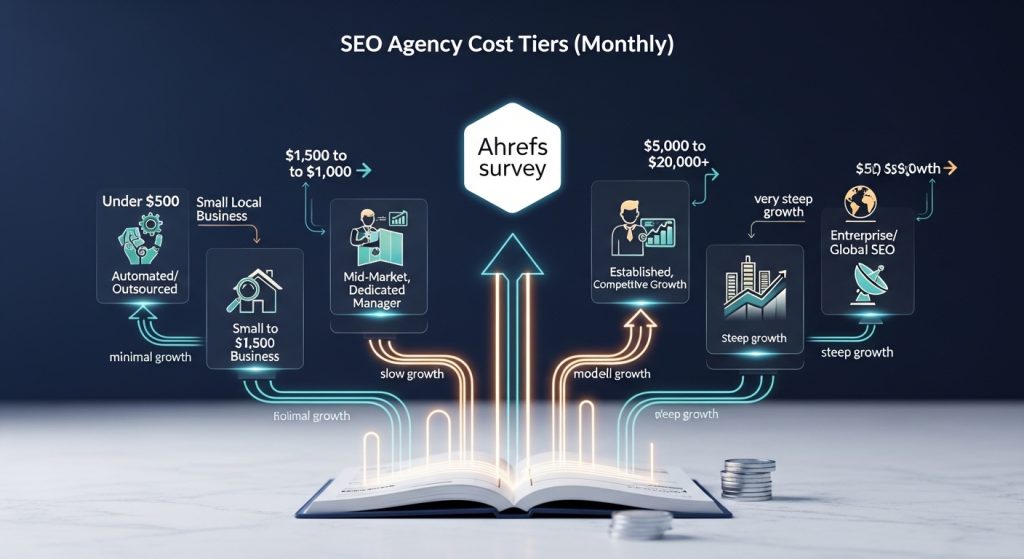
- Under $500/month: Almost always insufficient for any meaningful work. Common among resellers outsourcing to cheap providers.
- $500 to $1,500/month: Entry-level agencies. Suitable for small local businesses with low competition.
- $1,500 to $5,000/month: Mid-market range. More resources, dedicated account management, and broader deliverables.
- $5,000 to $10,000/month: Established agencies working with growing companies in competitive niches.
- $10,000 to $20,000+/month: Enterprise-level work for large sites, highly competitive industries, or international SEO.
One-time projects like an SEO audit typically cost between $500 and $5,000, depending on site size.
If an agency quotes you “full SEO services” for $200 a month, the work will either be automated, outsourced to the lowest bidder, or fake. Real SEO involves human time, and human time costs money.
7 Red Flags That Tell You an SEO Agency Is Not Worth Hiring
1. They Guarantee Specific Rankings
No one can guarantee a position on Google Search. If an agency promises you rank #1 within 30 or 60 days, they will use tactics that may work briefly before triggering a penalty.
2. They Refuse to Explain Their Link-Building Methods
Legitimate backlink acquisition is transparent. If they call it “proprietary,” that usually means paid links or link farms, both of which violate Google’s guidelines.
3. They Own Your Google Analytics or Google Search Console Access
Your accounts are your property. Any agency that requires ownership rather than delegated access is a risk. If you leave, you could lose your data history.
4. They Cannot Show You Relevant Case Studies
Not every agency can share client names, but they should be able to share anonymized results with real metrics. If the only proof they offer is testimonials and star ratings, press harder.
5. Their Proposal Arrives Within Hours of Your First Call
A properly tailored proposal takes time to build. A same-day proposal is a template with your name swapped in.
6. They Do Not Ask About Your Business Goals
An agency that jumps straight to talking about keywords and rankings without understanding your revenue model or customer base will not build a strategy that connects to actual business results.
7. No Mention of Core Web Vitals or Technical SEO
If an agency talks only about content and keywords but never mentions PageSpeed Insights, mobile SEO, or site health, they are leaving out a significant portion of modern SEO work.
What Good SEO Reporting Looks Like
One of the clearest signals of a capable agency is how they report results. Good reporting gives you enough information to understand what is happening and why.
A monthly SEO report should include:
- Organic traffic changes from Google Analytics, broken down by page or section
- Keyword ranking changes for your target terms, tracked through Google Search Console or a rank tracking tool
- New and lost backlinks that month
- Technical SEO fixes completed (with before/after context)
- Content published or updated
- Planned work for the next month
- Any external factors (algorithm updates, seasonal traffic shifts) that affected results
Reports that only show keyword ranking tables without context are not enough. Rank movement means little if traffic and conversion rate optimization are not also improving.
How Long Does SEO Take to Show Results?
A 2022 Ahrefs study found that fewer than 6% of newly published pages reach the top 10 search results within 12 months. Most pages that rank well are at least 2 to 3 years old. That does not mean you will wait 3 years to see anything. A reasonable breakdown looks like this:
- Months 1 to 2: Technical SEO fixes, full SEO audit, baseline tracking setup in Google Search Console and Google Analytics
- Months 3 to 4: First content pieces published, initial keyword tracking begins, some early movement on lower-competition terms
- Months 6 to 9: Measurable organic traffic growth for established sites. New sites may still be building authority.
- Month 12+: Consistent SERP visibility for target keyword clusters, compounding traffic from a growing content library
Any agency that promises meaningful results in 30 days is either working on extremely low-competition terms or using risky tactics.
SEO Tools Your Agency Should Be Using
A professional agency should use a combination of these tools, and you should have access to the data they generate.
| Tool | What It Is Used For |
|---|---|
| Google Search Console | Tracking organic impressions, clicks, indexing issues |
| Google Analytics | Traffic data, user behavior, conversion tracking |
| Ahrefs | Backlink analysis, keyword research, competitor research |
| SEMrush | Keyword tracking, site audits, competitor monitoring |
| Moz | Domain authority tracking, local SEO data |
| Screaming Frog | Technical SEO crawls, broken link detection |
| Google Tag Manager | Managing tracking scripts without developer help |
| PageSpeed Insights | Core Web Vitals and page speed analysis |
If an agency cannot name the tools they use or give you access to a custom dashboard with no third-party data behind it, you have no way to verify results independently.
In-House SEO vs. SEO Agency: When Does Hiring Outside Make Sense?
Some businesses eventually consider whether to build an in-house team instead of continuing with an agency. Here is a direct comparison.
| Consideration | In-House SEO | SEO Agency |
|---|---|---|
| Cost for a full team | $150,000+ per year in salaries | $2,000 to $10,000/month |
| Speed to start | 3 to 6 months (hiring + onboarding) | 2 to 4 weeks |
| Industry knowledge | Builds over time | Often already specialized |
| Tool access | Individual licenses | Agency accounts (often discounted) |
| Best for | Large businesses with complex needs | Most small to mid-size businesses |
For most businesses spending under $500,000/year on marketing, an agency is more cost-effective than building an in-house SEO team from scratch.
FAQs About Hiring an SEO Agency
1. How long does it realistically take to see results from SEO?
SEO is a long-term investment, not a quick win. In most cases, you will start seeing early movement—such as keyword ranking improvements or slight traffic increases—within 3 to 4 months. However, meaningful results like consistent traffic growth, lead generation, or revenue impact usually take 6 to 12 months.
The timeline depends on several factors, including your website’s current authority, competition in your industry, and how aggressive the SEO strategy is. If your site has technical issues or no existing content foundation, it may take longer. A good agency will set expectations clearly and show progress through leading indicators even before major results appear.
2. Is it better to hire an SEO agency or a freelancer?
It depends on your business size, goals, and budget. SEO agencies typically offer a team-based approach, meaning you get access to specialists in technical SEO, content, and link building. This makes them a better fit for businesses that need a comprehensive, scalable strategy.
Freelancers, on the other hand, are usually more affordable and can be highly effective for smaller projects or local businesses. However, they may have limitations in bandwidth and expertise across all SEO areas. If your needs are simple, a freelancer can work well. If you need full-service execution and long-term growth, an agency is often the better choice.
3. What are the biggest red flags when choosing an SEO agency?
Some warning signs are immediate deal-breakers. If an agency guarantees #1 rankings, promises results within 30 days, or avoids explaining their process clearly, you should be cautious. These are often signs of outdated or risky tactics.
Other red flags include a lack of transparency in reporting, vague answers about link-building practices, and long-term contracts with no exit clause. A trustworthy agency will be open about what they can and cannot control, and they will focus on sustainable growth rather than shortcuts.
4. How involved do I need to be after hiring an SEO agency?
SEO is not completely hands-off. While the agency will handle execution, your input is still essential. You may need to approve content, provide insights about your customers, and give access to internal data or tools.
The best results happen when there is ongoing collaboration. Expect to spend a few hours each month reviewing reports, joining strategy calls, and giving feedback. An agency that claims they need zero involvement from you is likely not tailoring the strategy to your business.
5. Can SEO actually generate revenue, or is it just about traffic?
SEO is not just about increasing traffic—it is about attracting the right traffic. A well-executed SEO strategy focuses on targeting keywords that align with buying intent, meaning users who are actively searching for solutions your business offers.
Over time, this leads to higher-quality leads, better conversion rates, and measurable revenue growth. However, this only works if the agency aligns SEO efforts with your business goals, not just vanity metrics like rankings or page views.
6. What should I expect in a monthly SEO report?
A proper SEO report should give you a clear picture of both performance and work completed. This typically includes organic traffic trends, keyword movement, conversions from search, and a summary of tasks completed during the month.
More importantly, it should also explain why results are changing and what actions will be taken next. Reports that only show rankings without context or strategy are not very useful. Transparency and clarity are key.
7. Do I need SEO if I am already running paid ads?
Yes, SEO and paid ads serve different purposes and work best together. Paid ads can generate immediate traffic, but the moment you stop spending, the traffic stops. SEO, on the other hand, builds long-term visibility that continues even without ongoing ad spend.
By investing in SEO, you reduce your reliance on paid acquisition over time and create a more sustainable traffic source. Many businesses use paid ads for short-term wins while building SEO for long-term growth.
8. Can a bad SEO agency actually harm my website?
Yes, and this is often underestimated. Poor SEO practices—such as spammy link building, keyword stuffing, or duplicate content—can lead to search engine penalties. These penalties can significantly reduce your visibility and take months (or even years) to recover from.
That is why vetting an agency properly is critical. A bad agency does not just waste your budget—it can actively damage your online presence.
Choosing the Right SEO Agency: A Final Checklist
Before you sign a contract, go through this list:
- The agency can explain its SEO strategy in plain language specific to your business
- You have spoken to the person who will actually work on your account
- You have seen at least 2 case studies with real traffic and conversion data
- Proposal includes specific monthly deliverables, not just service descriptions
- You retain ownership of all your data accounts
- Contract includes a 30 to 60-day exit clause
- The reporting format is clear and includes more than just keyword rankings
- Agency uses verifiable tools like Google Search Console, Ahrefs, or SEMrush
- No guarantee of specific rankings was made
If an agency checks all of these, the remaining question is whether their track record and team quality match your budget. For example, agencies like WiseRank follow a data-driven approach focused on traffic, leads, and long-term growth rather than generic packages, which is exactly what you should look for in a reliable partner. Take time with the decision. The agencies worth hiring will not rush you.
Browse verified SEO agencies at Top SEO Agencies — a platform for finding and comparing SEO agencies worldwide.