The most common answer to this question is ‘3 to 6 months’. That answer is true in a general sense and nearly useless in practice.
A local dental clinic in a mid-sized city and a new e-commerce store selling competitive products nationally are both starting SEO campaigns. They will not follow the same timeline. Not even close. The dental clinic might see page-one results for local terms in 10 weeks. The e-commerce store might not see meaningful organic traffic until month 9.
This article gives you specific, honest timelines based on your actual situation: what type of site you have, what condition it is in, and what you are trying to accomplish. It also covers what to track before results show up, what to do if 6 months pass with nothing to show, and how AI search visibility fits into the picture.
Why SEO Takes Time and Why That Cannot Be Short-circuited
Search engines like Google do not rank pages because someone asked them to. They rank pages because their Search Engine Algorithms have evaluated the page against hundreds of signals over time and determined it deserves a position.
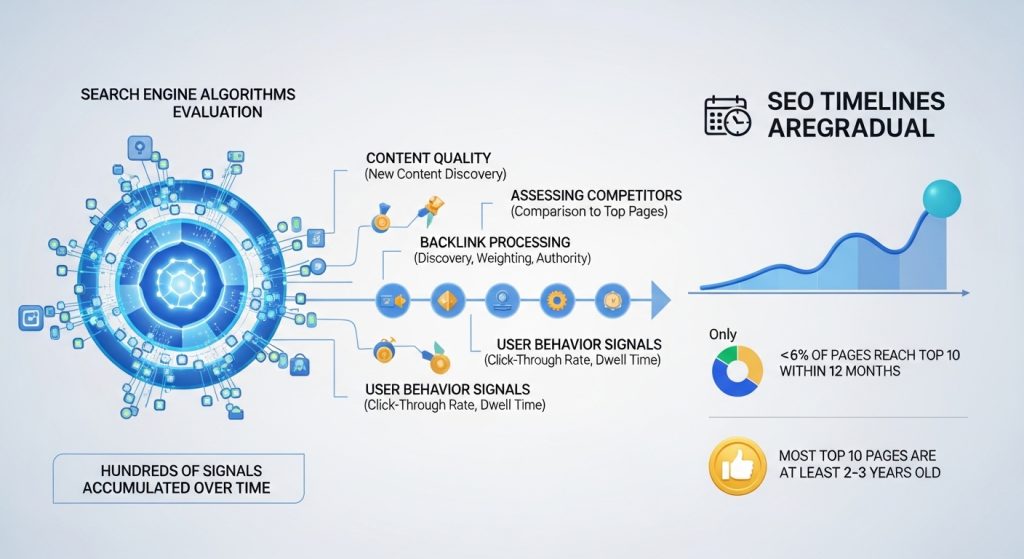
Those signals take time to accumulate. A new page needs to be crawled, then indexed, then evaluated for content quality, then assessed in relation to competing pages. Backlinks pointing to that page need to be discovered, processed, and weighted. User behavior signals, such as click-through rates and dwell time, need to be gathered. Each step takes time, and the process runs continuously as Google reassesses pages against new competitors and fresh content.
A 2022 Ahrefs study analyzing 2 million pages found that fewer than 6% of pages published that year reached the top 10 search results within 12 months. Most pages that rank in the top 10 are at least 2 to 3 years old.
That is not a reason to delay starting. It is a reason to set honest expectations before you begin.
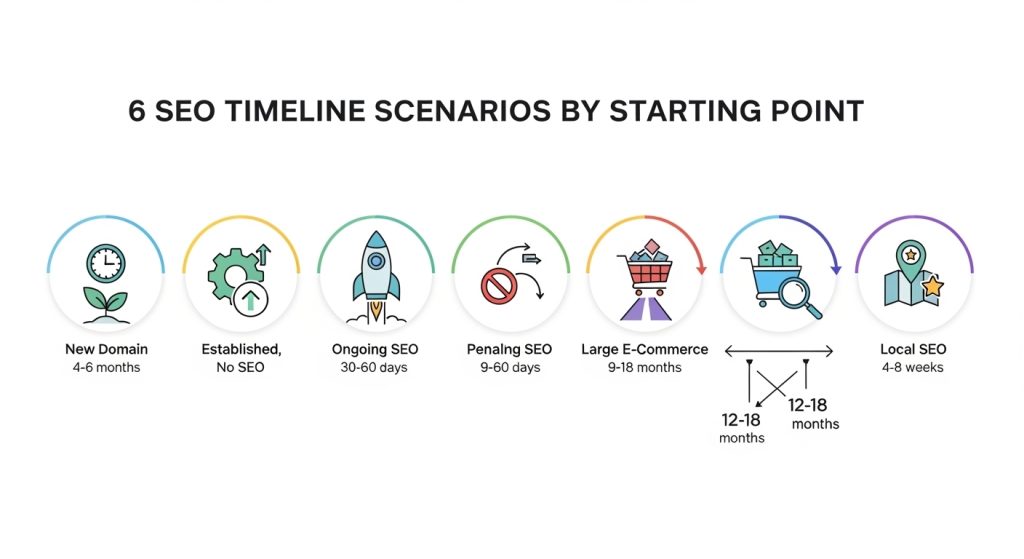
6 SEO Timeline Scenarios by Starting Point
This is the section no competitor provides. “New vs. established website” is not a useful distinction. Here is what actually determines your timeline.
Scenario 1: New Domain (No History)
New domains face an unofficial evaluation period where Google crawls and indexes content but delays significant rankings while assessing trust and authority. This period typically lasts 4 to 6 months.
During this time, you will see content getting indexed in Google Search Console but ranking at low positions. Impressions will slowly increase. Traffic will remain minimal until the site builds enough authority through Content Marketing and Link Building.
Realistic timeline for a new domain: first meaningful keyword rankings in months 4 to 7, consistent organic traffic by month 9 to 12.
Scenario 2: Established Site, No SEO
This is actually the most promising starting scenario. An established site already has domain authority, crawl history, and potentially some backlinks built organically over time. The problem is that the content and technical structure have never been optimized.
When structured SEO begins on a site like this, improvements can appear relatively fast. Technical fixes implemented in weeks one and two are often reflected in Google Search Console within 30 to 60 days. Content improvements on existing pages can move rankings noticeably within 60 to 90 days.
Realistic timeline: visible ranking improvements within 60 to 90 days, measurable organic traffic growth by months 4 to 6.
Scenario 3: Established Site with Ongoing SEO
When a site already has a working SEO foundation and brings in an agency to accelerate it, the timeline compresses. Baseline authority and trust are already established. Technical health is likely acceptable. The work is optimization and expansion rather than foundation-building.
Realistic timeline: improvements visible within 30 to 60 days, measurable traffic increases within 3 to 4 months.
Scenario 4: Recovering from a Google Penalty
A site that received a manual action for link spam, thin content, or cloaking starts from a deeply negative baseline. Before any standard SEO work can produce results, the penalty-causing issues must be fixed completely, a disavow file submitted if links are the cause, and a reconsideration request approved by Google’s review team.
That process alone takes 3 to 6 months in many cases. Only after the penalty is lifted does standard SEO work begin to show effect, which adds another 4 to 9 months.
Realistic timeline: 9 to 18 months minimum from the start of remediation before meaningful organic traffic returns.
Scenario 5: Large E-Commerce Site
E-commerce SEO involves additional complexity: product page optimization, category page structure, duplicate content from product variants, structured data for product schema, and the ongoing challenge of indexing thousands of pages without overwhelming crawl budget.
Google Search Algorithms process large sites more slowly than small ones. JavaScript-heavy platforms can take significantly longer to crawl and render, sometimes 9 times longer than simple HTML sites, according to Search Engine Land’s research.
Realistic timeline: initial product ranking improvements in months 3 to 5, meaningful category page visibility by months 6 to 9, full site performance improvements by months 12 to 18.
Scenario 6: Local Business SEO
Local SEO operates differently from national organic search. It targets users who are searching for a service in a specific geographic area, and the competition is usually far less than in national markets.
Google Business Profile optimization, local citation building, and location-specific page content can produce visible results in 4 to 10 weeks in moderately competitive local markets. In highly competitive cities (major metro areas), the timeline extends to 3 to 6 months for local pack visibility.
Realistic timeline: Google Business Profile improvements visible in 4 to 8 weeks, local keyword rankings improving in 2 to 4 months.
SEO Timeline by Site Type: Quick Reference Table
| Site Type | First Signs of Movement | Consistent Organic Traffic | Full Campaign Momentum |
| Brand new domain | Months 4 to 5 | Months 9 to 12 | Months 12 to 18 |
| Established, no prior SEO | Months 2 to 3 | Months 4 to 6 | Months 8 to 12 |
| Established, continuing SEO | Months 1 to 2 | Months 3 to 4 | Months 6 to 9 |
| Recovering from a penalty | Months 6 to 9 | Months 12 to 15 | Months 15 to 18 |
| Large e-commerce | Months 3 to 5 | Months 6 to 9 | Months 12 to 18 |
| Local business | Week 4 to 8 | Months 2 to 4 | Months 4 to 8 |
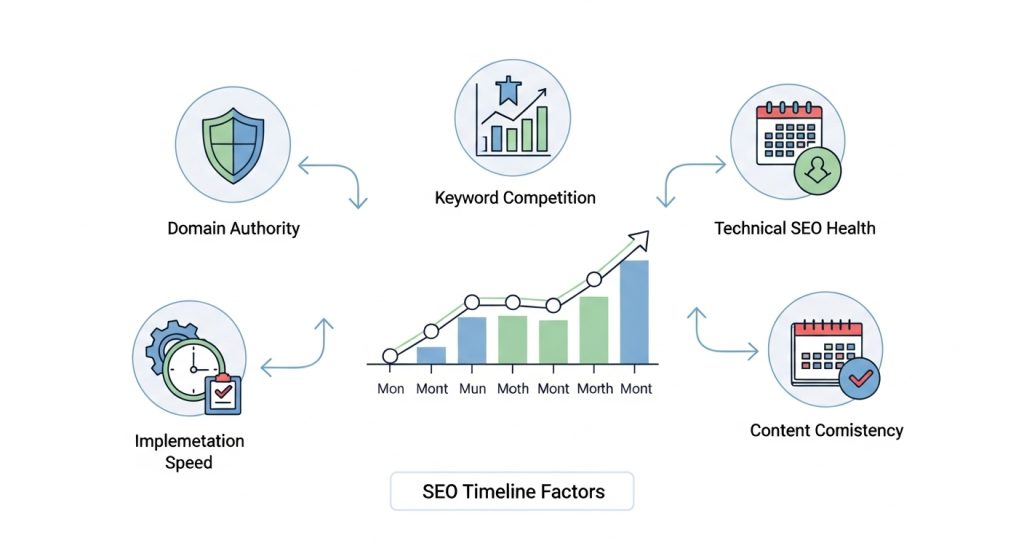
5 Key Factors That Impact SEO Timelines
1. Domain Authority and Trust History
Search Engine Algorithms assign more trust to websites with a longer history of quality content and legitimate backlinks. An older domain with a clean history can see results in 3 to 4 months that a brand-new domain would not see until month 9 or 10. This is not something you can change overnight, but it is why starting SEO earlier rather than later is always better.
2. The Competitiveness of Your Target Keywords
A local plumber in a small city can rank on page 1 for “plumber [city name]” in 6 to 10 weeks with good local SEO work. A financial services company trying to rank for “personal loans” is competing against billion-dollar brands with decades of Domain Authority built up through Link Building and earned media. The keyword difficulty score in tools like Ahrefs or SEMrush gives you a rough sense of how long it will take to rank.
3. Technical SEO Health at the Start
If a site has critical technical issues such as crawl errors, slow page load times, duplicate content across hundreds of pages, or poor mobile usability, those problems need to be fixed before any content or link work produces results. A site with major technical debt effectively adds 1 to 3 months to any SEO timeline because fixes need to be implemented, crawled, and processed before the benefits appear.
4. How Quickly Recommendations Get Implemented
This factor rarely appears in competitor articles, and it is often the most important one in practice. When an SEO agency identifies a set of technical fixes or content improvements, those recommendations need to be implemented by someone, often a development team that has other priorities.
Large companies where the development roadmap is controlled by product managers, not marketing teams, may take 3 to 6 months to implement SEO recommendations that would take a small business 2 weeks. Every month of delay is a month of missed compounding organic growth.
5. Content Consistency and Publishing Cadence
Topical authority builds through consistent content published over time. A site that publishes 4 strong, well-researched articles per month builds authority faster than a site that publishes 20 thin posts in one month and nothing for the next three. Google’s systems assess content patterns over time, not just individual pieces. Consistent publishing creates a reliable crawl pattern and signals that the site is actively maintained.
What to Track Before Results Show Up: Leading vs. Lagging Indicators
Most business owners watch the wrong metric at the wrong time. They check organic traffic at month 2, see almost nothing, and assume SEO is not working. Here is how SEO results actually appear, in order.
Leading Indicators (Appear First, Often Within 4 to 8 Weeks)
These show up in Google Search Console and signal that the SEO work is being processed by Google even before rankings improve:
- Indexed pages increasing: New content getting added to Google’s index shows that crawling is healthy
- Impressions rising: Your pages are appearing in search results, even at low positions
- Crawl frequency increasing: Google is visiting your site more often, a sign of growing interest
- Core Web Vitals improvements: Technical fixes showing up in Google Search Console’s experience report
Lagging Indicators (Appear After Leading Indicators)
These are the results most clients focus on, but they follow the leading indicators by weeks or months:
- Keyword ranking improvements: Positions moving from page 3 to page 2 to page 1 over the months
- Organic traffic growing: Actual clicks from search results increasing in Google Analytics
- Lead generation or sales from organic: Revenue impact from organic search, the final indicator
If impressions and crawl frequency are growing but traffic is not yet, SEO is working. Patience is appropriate. If impressions are flat after 90 days of consistent work, something is wrong with the crawling, indexing, or content quality.
Local SEO Has a Faster Timeline: What to Expect
Local SEO deserves its own section because the timeline is genuinely different from what most articles describe.
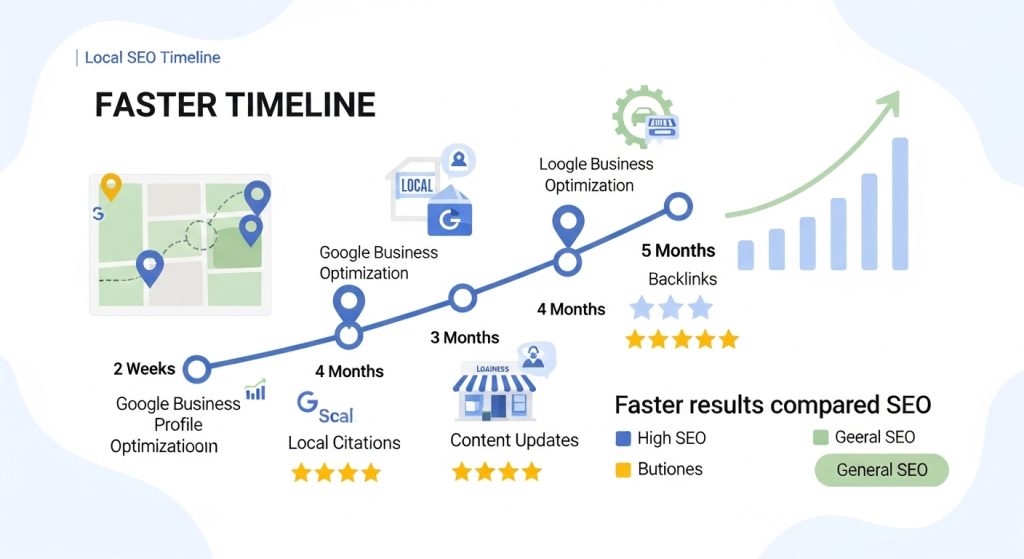
For a business serving customers in a specific geographic area, the most important ranking signals are:
- Google Business Profile completeness and review volume
- Local citations (name, address, phone number consistency across directories)
- Location-specific content on the website
- Backlinks from local news sites, directories, and community organizations
Google Business Profile optimization can produce results within 2 to 4 weeks in less competitive markets. Map Pack visibility for a local search term often appears before the website itself ranks for that term organically.
In moderately competitive local markets (small to mid-size cities), a well-executed local SEO campaign typically produces measurable results within 6 to 10 weeks. In highly competitive markets like major metro areas, the timeline extends to 3 to 5 months for meaningful visibility.
AI Search Visibility: A Newer Timeline Most Articles Ignore
In 2026, appearing in Google AI Overviews, ChatGPT search results, and Perplexity is a meaningful source of visibility for many queries. This follows a different timeline from traditional Website Ranking.
AI-generated search answers pull from content that demonstrates clear topical authority, uses structured question-and-answer formats, and provides direct, specific information rather than general overviews. Content needs to be indexed and crawled first, then it needs enough topical authority for AI systems to treat it as a reliable source.
For a new site, appearing in AI-generated answers typically takes 6 to 12 months of consistent, expert-level content production. For established sites with strong domain authority, targeted content written specifically to answer specific questions can appear in AI Overviews within 2 to 4 months.
This is worth tracking separately from organic rankings in Google Analytics and Google Search Console. Some businesses are finding that AI Overview appearances drive significant branded traffic even for terms where they do not rank in the traditional top 10.
What to Do If 6 Months Pass with No Measurable Results
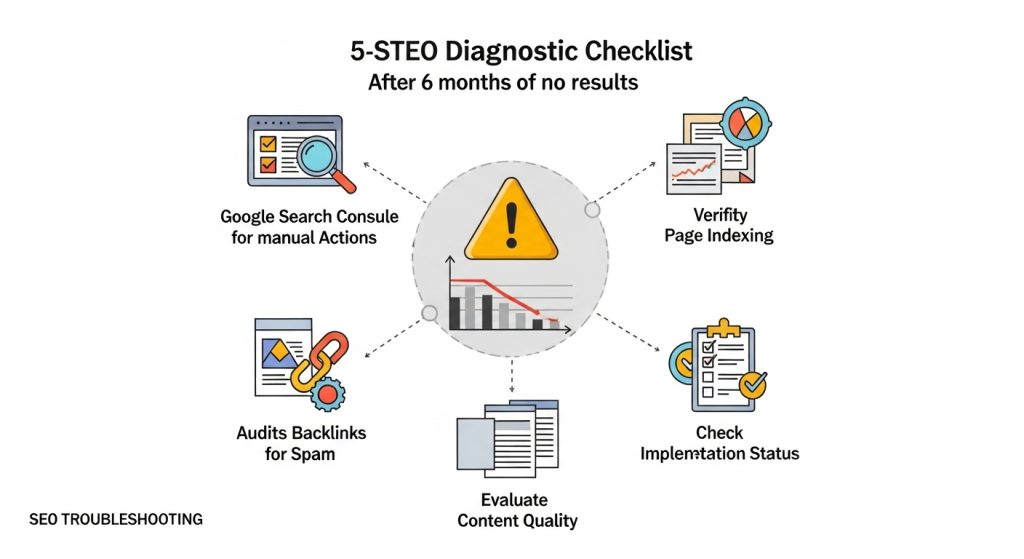
This diagnostic section appears nowhere in the competitive landscape and answers one of the most high-intent follow-up searches on this topic.
If 6 months of SEO work have produced no measurable improvement in impressions, rankings, or traffic, work through this checklist before assuming the agency is at fault or the strategy is wrong.
Step 1: Check for manual actions in Google Search Console.
Open Google Search Console and navigate to Security and Manual Actions. If a manual action exists, it will suppress rankings regardless of any other work done. This is the first thing to check because it makes everything else irrelevant.
Step 2: Verify that key pages are actually indexed.
In Google Search Console, use the URL Inspection tool on your 5 most important pages. If they are not indexed, nothing else matters. Common causes of non-indexing include noindex tags left in from development, robots.txt blocking, or crawl budget exhaustion on large sites.
Step 3: Audit the backlink profile for recent spam.
Run the domain through Ahrefs or SEMrush and filter backlinks by date. A sudden spike in low-quality backlinks in the months after SEO work began may indicate the agency used low-quality link building that is suppressing rather than helping rankings.
Step 4: Assess content quality on the pages you care about most.
Compare your top content pages against the top 3 ranking pages for the same keywords. Are they as specific, as detailed, and as clearly organized? Do they answer the question better or worse than what is currently ranking? Content that is not clearly better than existing results will not displace them.
Step 5: Check implementation lag.
How many of the agency’s technical recommendations have actually been implemented? If fixes have been sitting in a backlog for 3 months, the SEO work has effectively not started yet.
SEO Timeline: Month-by-Month Milestones
This is written from the client’s perspective, which no competitor article provides.
| Month | What Should Be Complete | What You Should See in Data |
| Month 1 | Technical audit, keyword strategy, baseline tracking setup | Baseline data in Google Search Console and Google Analytics established |
| Month 2 | Technical fixes implemented, first content pieces published | Indexed page count growing, crawl frequency increasing |
| Month 3 | 8 to 12 pieces of content live, link outreach underway | Impressions rising for target terms, some position movement on low-competition keywords |
| Month 4 | Content strategy in full production, early backlinks earned | Ranking improvements on 5 to 10 target keywords, first organic traffic growth |
| Months 5 to 6 | Ongoing content, link building, reporting, and refinement | Measurable organic traffic growth compared to baseline, lead, or sale attribution beginning |
If the agency cannot show specific deliverables matching the left column by each month, the timeline will extend further. Deliverables drive data. Data drives decisions.
FAQs About SEO Timelines
How long does SEO take for a brand-new website?
A brand new domain typically takes 4 to 7 months to see its first meaningful keyword rankings, and 9 to 12 months before consistent organic traffic develops. New sites face an evaluation period where Google builds trust signals before rewarding rankings. This can be accelerated by strong technical SEO from launch and consistent, high-quality content published on a regular schedule.
Can SEO produce results in 30 days?
Rarely, and only in specific circumstances. A local business with no prior Google Business Profile can see map pack visibility in 30 days. An established site with previously unoptimized title tags and meta descriptions can see click-through improvements within 30 days of on-page fixes. But meaningful ranking or traffic improvement in 30 days on competitive keywords is not realistic, and any agency claiming otherwise is using tactics that create long-term risk.
Why does my competitor rank faster than I, even though we started SEO at the same time?
Domain Authority differences are the most common explanation. A competitor with 5 years of organic history, accumulated backlinks, and established topical authority will outrank a newer site on the same keywords regardless of how good the newer site’s content is in the short term. The newer site needs to build authority through consistent Link Building and content over time.
Is local SEO faster than national SEO?
Yes, significantly. Local SEO campaigns targeting a specific city or region can show measurable results in 4 to 10 weeks in most markets. National Organic Search campaigns in competitive industries typically take 6 to 12 months for meaningful results. The difference is competition: there are far fewer websites competing for “plumber in [city]” than for “best project management software.”
How do I know if my SEO is working before traffic improves?
Watch the leading indicators in Google Search Console: rising impressions, more pages getting indexed, and increasing crawl frequency. These appear before ranking improvements, and ranking improvements appear before traffic grows. If impressions are rising consistently month over month, the SEO work is producing effects even if traffic has not yet followed.
How long does it take to appear in Google AI Overviews?
For new sites or new topic areas, appearing in AI Overviews typically takes 6 to 12 months of consistent expert-level content production. For established sites with existing Domain Authority, specifically structured content answering clear questions can appear in AI-generated search results within 2 to 4 months after publication and indexing.
Conclusion
SEO does not have a single timeline. It has a range of timelines determined by your starting point, your market, the type of work being done, and how quickly that work gets implemented.
The clearest path forward is to start with honest baseline tracking in Google Search Console and Google Analytics, understand which leading indicators to watch before traffic improves, and hold whoever is doing the SEO work accountable to specific deliverables each month.
For finding agencies with transparent timelines and real case study data, platforms like Top SEO Agencies list verified providers with independent reviews so you can compare claims against client-reported outcomes.
Browse verified SEO agencies at Top SEO Agencies