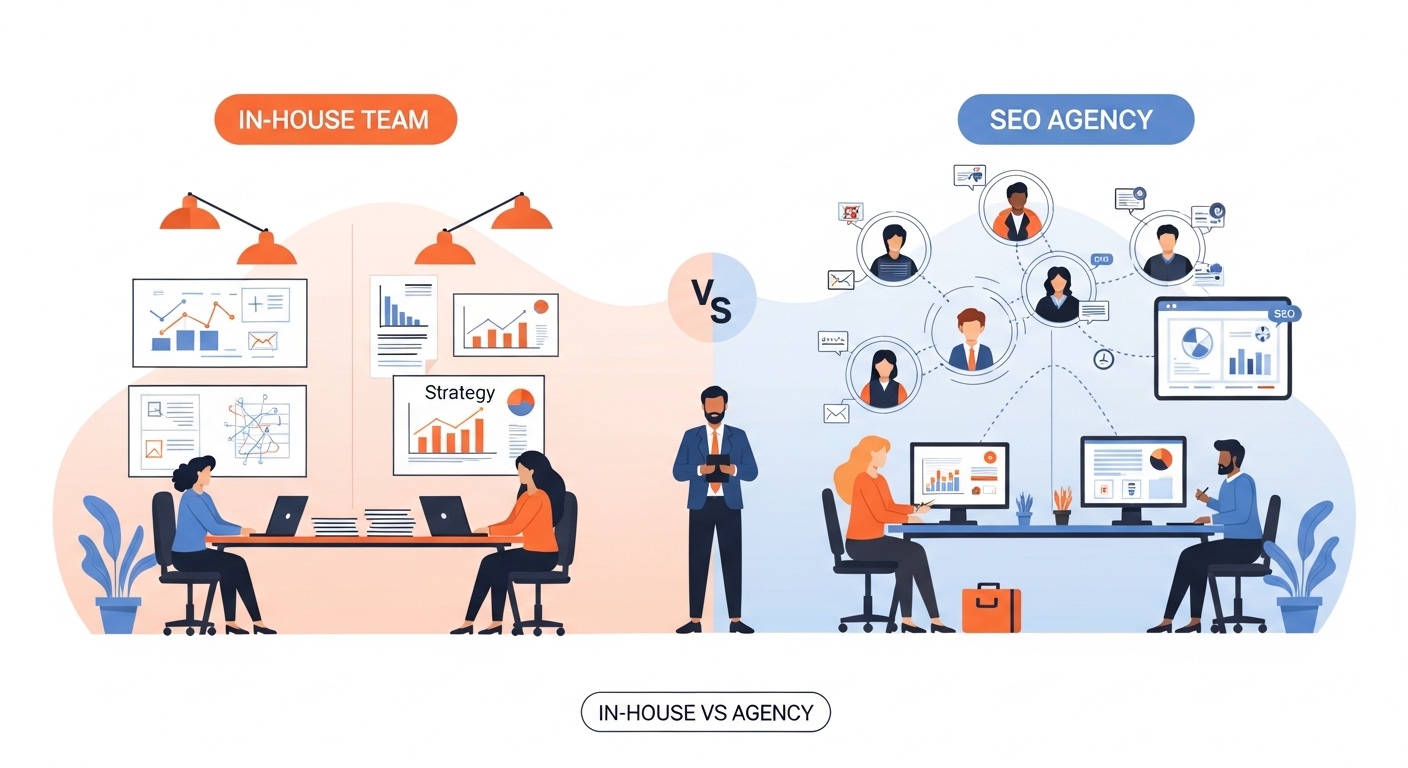
At some point, every business that takes Search Engine Optimization seriously faces this decision. Do you hire internal people and build a team you own and control, or do you bring in an external SEO agency that already has the expertise, tools, and processes in place?
Both options work. Both have real limitations. And the right answer depends almost entirely on your business situation, not on a general preference for one model over the other.
This guide walks through what each option actually costs, where each one performs better, what the hidden trade-offs are, and a specific decision framework to help you figure out which path makes sense for you right now.
What In-House SEO Actually Means in Practice
In-house SEO means hiring one or more people directly as employees to manage your Search Engine Optimization internally. They work within your marketing team, have direct access to your business context, and build their knowledge of your brand, customers, and products over time.
For small businesses, in-house SEO often starts as one person handling everything: keyword research, content briefs, technical fixes, reporting in Google Search Console and Google Analytics, and whatever link building gets done. As the company grows, that person becomes a team with defined roles.
- Specialised roles improve results as the team grows
- Better alignment with business goals
- Faster execution without external delays
- Higher cost (salaries, tools, hiring)
- Stronger long-term knowledge of your business
An in-house SEO team typically includes some combination of an SEO strategist or manager, a content writer or editor, a technical SEO specialist, and a link builder or digital PR person. Getting to that full team from zero requires significant hiring time, onboarding, tool investment, and salary budget.
What an SEO Agency Actually Provides
An SEO agency is an external company that manages some or all of your Search Engine Optimization as a service. You pay a monthly retainer or project fee in exchange for a team of specialists who work across your account alongside other clients.
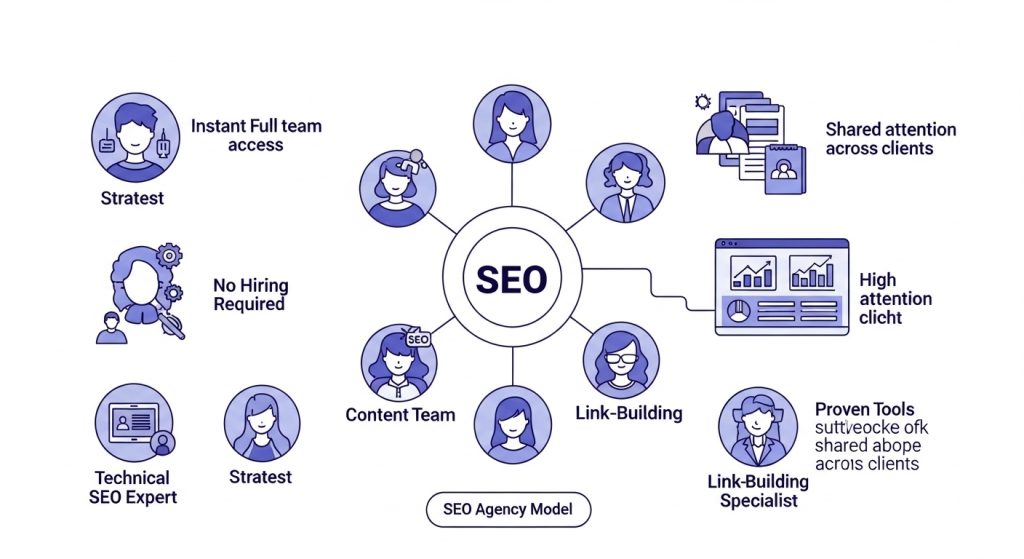
A full-service agency typically brings a strategist, technical SEO specialist, content team, and link-building operation to your account without you having to hire or manage any of those people individually. They arrive with tools, processes, and experience already built out.
- Access to a full team instantly (strategy, content, technical, links)
- No hiring or training required
- Proven systems and tools already in place
- Lower upfront cost than building in-house
- Less control and shared attention across clients
The trade-off is that your account shares attention across the agency’s client base, you have less control over who specifically does your work, and institutional knowledge about your business builds more slowly than it does with an internal employee who is with you full-time.
The Real Cost Comparison
Cost is usually the first question, but the numbers are often misunderstood because the comparison is rarely apples-to-apples.
What an In-House SEO Team Actually Costs
A single mid-level SEO manager in a competitive market typically costs between $55,000 and $90,000 per year in salary, depending on location. Add employer taxes, benefits, paid leave, and equipment, and the true employment cost is typically 1.2 to 1.4 times the salary figure.
For a full in-house SEO team covering strategy, content, technical, and link building, the annual staff cost typically runs between $200,000 and $400,000 in markets like the United States, the United Kingdom, and Australia. Add software tools (Ahrefs or SEMrush at $2,000 to $5,000 per year, Screaming Frog, Google Analytics, project management tools) and training budgets, and the annual operating cost of a capable in-house team is significant.
What Does an SEO Agency Cost
According to a 2023 survey by Ahrefs covering nearly 500 SEO professionals globally, here are the typical monthly retainer ranges:
- $500 to $1,500 per month: Entry-level agencies, suitable for small local businesses
- $1,500 to $5,000 per month: Mid-market agencies with dedicated account management
- $5,000 to $10,000 per month: Established agencies for growing businesses in competitive industries
- $10,000 to $20,000+ per month: Enterprise-level work or highly specialized campaigns
At $3,000 per month, you are spending $36,000 per year on SEO. That is the cost of one mid-level employee before benefits, and it gets you an entire team of specialists rather than one generalist.
The Real Cost Equation
| Factor | In-House SEO Team | SEO Agency |
| Annual base cost (full team) | $200,000 to $400,000+ | $18,000 to $120,000 |
| Speed to productivity | 3 to 6 months (hiring + onboarding) | 2 to 4 weeks |
| Breadth of skills | Depends entirely on who you hire | Full team from day one |
| Business context | Deep, grows over time | Takes 3 to 6 months to build |
| Control over priorities | Full | Shared with the agency’s workflow |
| Risk when a key person leaves | High | Low (team replaces individual) |
| Tool costs | Additionally, significant | Usually included in retainer |
For most businesses spending under $500,000 per year on total marketing, an agency is significantly more cost-effective than a full in-house team.
Where In-House SEO Genuinely Outperforms an Agency
Cost efficiency alone does not make the agency the right answer in every situation. There are specific scenarios where building an internal team produces better results.
When Your Business Requires Deep Domain Expertise
Industries like healthcare, financial services, legal services, and regulated products require content that reflects deep, accurate domain expertise. A law firm writing about legal proceedings, a medical practice writing about conditions and treatments, or a financial services firm writing about investment products cannot rely on generalist content writers, regardless of how experienced they are in SEO.
In these cases, an in-house writer who understands the domain and the regulatory environment produces meaningfully better content than a capable agency writer who does not. Google’s evaluation of YMYL (Your Money or Your Life) content specifically rewards demonstrated expertise, which is easier to build internally over time.
When Execution Depends on Internal Access
Some technical SEO work requires access to systems, databases, and code that external agencies cannot easily reach. If your website is custom-built on a proprietary stack, or if your product pages pull from a database with complex logic, a technical SEO specialist sitting inside the engineering team can implement fixes in days rather than weeks of back-and-forth communication.
For e-commerce businesses with thousands of product pages, in-house technical SEO often executes faster simply because the person doing the work has direct access to the CMS, the development team, and the data.
When SEO Must Align with Real-Time Business Decisions
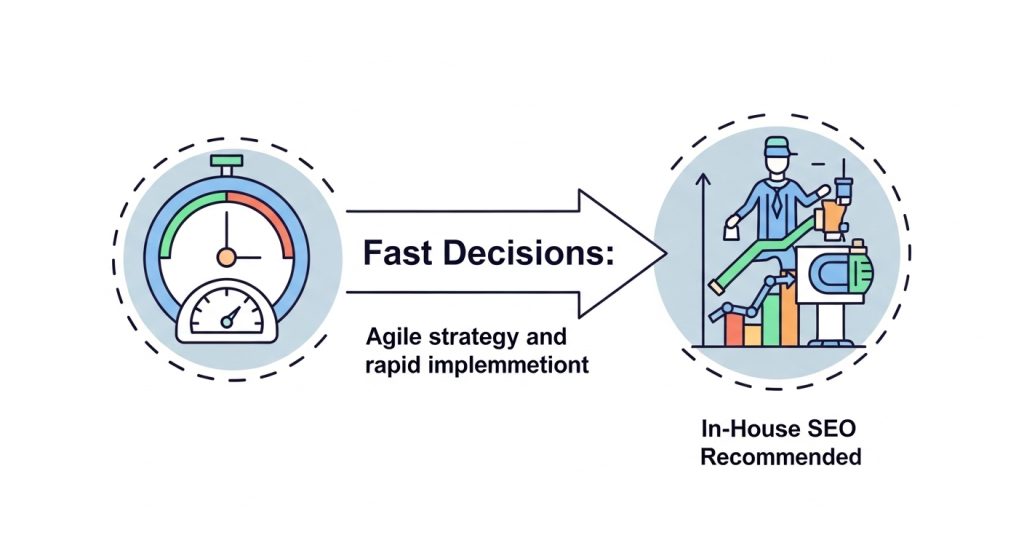
Marketing strategy changes fast. When a business launches a new product, enters a new market, or responds to a competitor’s move, the SEO implications need to be addressed immediately. An in-house SEO person in the room when these decisions are made can integrate organic search considerations from the start rather than catching up after the fact.
An agency always has a communication lag. Even a highly responsive agency account manager is not in your team meeting when strategy shifts. That lag compounds over time in fast-moving businesses.
When You Are at Enterprise Scale
At enterprise scale, the economics flip. A large corporation with hundreds of web properties, millions of pages, and dedicated engineering, content, and marketing teams has both the budget and the operational need for a full in-house SEO function. At that scale, an agency cannot maintain the depth of product knowledge or the pace of execution the business requires.
Where an SEO Agency Outperforms In-House SEO
Faster Results Than Hiring
Hiring one capable SEO professional takes 6 to 12 weeks of sourcing, interviewing, and making an offer. Onboarding takes another 4 to 8 weeks. Getting to productive output on a new strategy takes another 1 to 2 months after that.
An agency with established processes can begin a technical audit in week one, publish a strategy document by week three, and have content and link-building work underway by month two. For businesses that need organic search to grow now rather than in six months, the speed advantage of an agency is real and significant.
Broad Skills Without a Full Team
Most small and mid-size businesses need competent work across technical SEO, content, link building, and Lead Generation through organic search. But they do not have the volume of work to justify hiring four separate specialists. An agency provides all four disciplines in one retainer without the overhead of managing four headcounts.
Accountability Without Managing Specialists
Managing an in-house SEO team requires someone with enough knowledge to evaluate their work, set meaningful goals, and identify when performance is poor. Most business owners and general marketing leaders do not have that SEO depth.
An agency with good reporting structures delivers accountability through the contract itself: deliverables are named, results are tracked in Google Search Console and Google Analytics, and poor performance is visible in the monthly report. That accountability structure is easier to manage than evaluating the day-to-day work of an internal team.
Flexible SEO Support as Needs Change
Some businesses have intensive SEO needs during certain periods (a site migration, a new product launch, a major content push) and lighter needs in between. A monthly agency retainer can be scaled up or down more easily than a permanent headcount. Hiring and then laying off an in-house team is operationally and culturally expensive. Adjusting an agency scope is a contract conversation.
The Hybrid Model: When Neither Option Works Alone
Many businesses at the growth stage find that neither pure option serves them well. The hybrid model places a small in-house SEO function in charge of strategy, business context, and quality control, while an agency handles execution of specific services like link building, content production at scale, or technical audits.
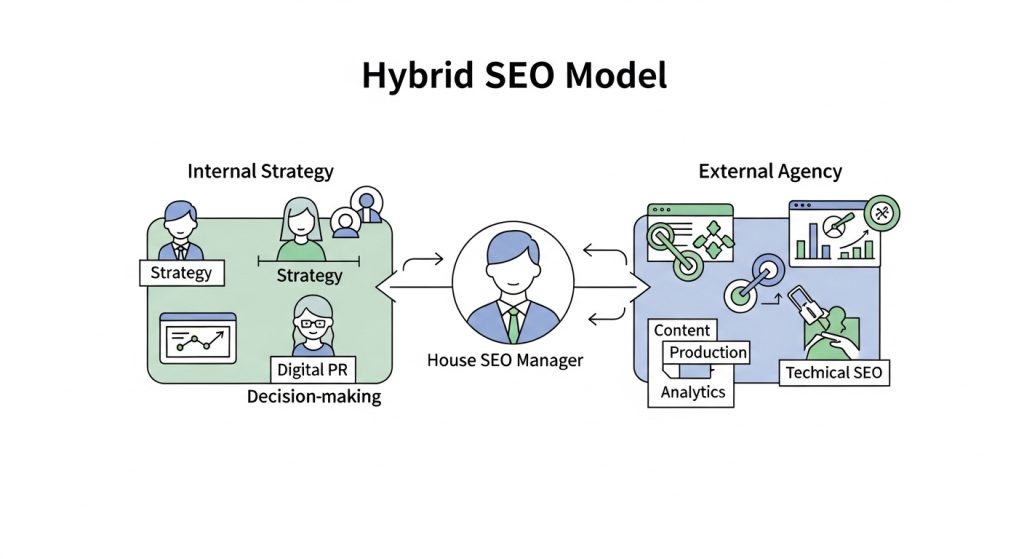
A common hybrid structure looks like this:
- 1 in-house SEO manager or director who owns the Digital Marketing Strategy and serves as the primary point of contact for all SEO decisions
- An agency or specialist provider handling link building and digital PR, where the volume and relationship network of the agency adds value
- Freelance content writers with industry expertise are managed by an in-house person
This structure gives businesses the institutional knowledge advantage of in-house SEO while accessing the execution capacity and specialist expertise of external providers for the services that benefit most from scale.
A Decision Framework: Which Option Fits Your Situation Right Now?
Choose an SEO Agency if:
- Your annual marketing budget for SEO is under $150,000
- You need results to begin within 60 to 90 days, not 6 months
- You lack someone internally with enough SEO knowledge to evaluate and direct an in-house hire
- Your SEO needs span technical, content, and link building simultaneously
- You are testing whether SEO is worth investing in before committing to headcount
Build an In-House SEO Team if:
- Your business is at a scale where SEO generates or influences over $1 million in annual revenue
- Your content requires deep domain expertise that cannot be replicated by a generalist writer
- Your technical stack requires internal access for SEO implementation
- You have enough SEO work to occupy a specialist full-time without relying on agency scope flexibility
- You have a senior leader who can hire, evaluate, and manage SEO talent effectively
Consider the Hybrid Model if:
- You have one capable in-house SEO person, but cannot afford or fill a full team
- Your link-building needs exceed what one person can manage alone
- You need specialist content writers for multiple topic areas simultaneously
- You want strategic control internally, but execution capacity externally
In-House SEO vs SEO Agency: Full Comparison by Business Stage
| Business Stage | Recommended Model | Primary Reason |
| Pre-revenue or early stage | Agency (small budget) | Speed and flexibility without headcount risk |
| Growing SMB ($1M to $10M revenue) | Agency or hybrid | Cost efficiency across all SEO disciplines |
| Scaling business ($10M to $50M) | Hybrid | Strategy internally, execution externally |
| Mid-market ($50M to $200M) | In-house team with agency support | Volume and speed justify internal headcount |
| Enterprise ($200M+ revenue) | Full in-house SEO function | Scale and complexity require a dedicated team |
FAQs
Is it cheaper to hire an SEO agency or build an in-house team?
For most businesses, an SEO agency is significantly cheaper when you account for the full cost of internal employment: salary, benefits, employer taxes, tools, training, and management time. A full in-house SEO team capable of covering technical, content, and link building typically costs $200,000 to $400,000 per year. A mid-range agency retainer runs $18,000 to $60,000 per year for comparable output.
How long does it take to see results from an in-house team vs an agency?
An agency with established processes typically begins productive work within 2 to 4 weeks and shows measurable progress in Google Search Console within 3 to 6 months. An in-house hire, accounting for recruiting, onboarding, and ramp-up time, typically reaches full productivity 4 to 6 months after the decision to hire. Neither model delivers instant results, but agencies start faster.
Can a small business manage SEO in-house without a specialist?
Partially. A non-specialist can handle basic on-page optimization, maintain content publishing, and use Google Search Console for monitoring. But technical SEO, strategic keyword research, and link building require specialist knowledge. Without that knowledge, small businesses often stagnate at a certain organic traffic level and cannot identify why.
What happens to my SEO if my in-house SEO manager leaves?
It depends on what they built while they were there. If documentation, keyword strategies, link profiles, and technical implementations are well documented, a replacement can continue the work. If the knowledge lived in one person’s head, significant time is lost during the transition. Agencies carry less single-person risk because the team structure replaces individual contributors.
Should I hire an agency before or after hiring an in-house SEO person?
For most businesses, starting with an agency makes more sense. An agency builds your baseline performance, develops an initial strategy, and gives you a benchmark for what good SEO output looks like before you hire internally. An in-house hire then has a documented foundation to build on rather than starting from scratch.
Conclusion
In-house SEO and SEO agency work are not competitors. They are tools. The right tool depends on your budget, your timeline, your business’s operational structure, and whether you have the internal capacity to hire, evaluate, and manage SEO talent effectively.
For most small and mid-size businesses, starting with an agency and transitioning to a hybrid model as the business grows is the path that produces results fastest without overcommitting resources.
If you are evaluating SEO agencies, platforms like Top SEO Agencies list verified agencies with real reviews, so you can compare options based on actual client outcomes rather than sales pitches.
Browse verified SEO agencies at Top SEO Agencies