
Most business owners read an SEO contract once, look at the price and the deliverables section, and sign. Every other clause gets skimmed or skipped entirely.
That is exactly how clients end up stuck in 12-month contracts with no exit, lose access to their Google Analytics data when they leave, and have no legal recourse when an agency’s link-building causes a Google penalty that takes 14 months to fix.
A contract is not a formality. It is the only document that protects you if the relationship goes wrong. This guide walks through every major clause, what the client-favorable version looks like, what the agency-biased version looks like, and which ones you should push back on before signing.
Why the SEO Contract Matters More Than the Pitch
During the sales process, an agency shows you its best work, makes realistic-sounding projections, and creates a good impression. None of that is legally binding. The contract is.
If deliverables are vague in the contract, you cannot hold the agency accountable for missing them. If the exit clause requires 90 days’ notice on a 6-month agreement, you are effectively locked in for the entire term. If the contract says nothing about who owns your Google Search Console account, you may find out the hard way when you try to leave.
Read the full contract before signing. If something is unclear, ask for clarification in writing. If something is unfair, negotiate it. Professional agencies expect this and welcome informed clients.
The 4 Types of SEO Contracts and What Changes Between Them
Not all SEO contracts are the same structure. The type of engagement you agree to determines which clauses matter most.

Monthly Retainer Contract
The most common structure. You pay a fixed monthly fee in exchange for ongoing SEO work: content, technical fixes, link building, and reporting. The key clauses to watch are exit terms, deliverable specifics, and performance accountability. Since the relationship is ongoing with no natural endpoint, termination and accountability clauses carry the most risk if they are poorly written.
Project-Based Contract
Used for defined, one-time work such as a technical SEO audit, a site migration, or a keyword research project. The most important clause here is the scope of work. If the project scope is vague, the agency can deliver far less than you expected and still claim full payment. Get deliverables listed as specifically as possible.
Performance-Based Contract
Payment is tied to results such as ranking positions, organic traffic targets, or lead volumes. These contracts sound appealing but require extremely careful drafting. The performance metric, measurement method, reporting tool, and baseline starting point all need to be agreed in writing before work begins. Dispute potential is high if any of these are left undefined.
White-Label Contract
Used between agencies, where one agency outsources SEO work to another under their own brand. If you are the end client, you may not even know your agency is using a white-label provider. This is worth asking about directly. A sub-contracting disclosure clause should be included if you want to know who is actually doing the work.
Clauses You Should Demand in Every SEO Contract
A Specific Scope of Work with Named Monthly Deliverables
The scope of work is the most important clause in any SEO contract and the one most commonly written to favor the agency. A vague scope of work uses language like “ongoing SEO optimization,” “regular content updates,” or “link building activities.” These phrases mean nothing without specifics.
What you should demand instead is a numbered list of deliverables per month. Something like: 4 pieces of content per month of 1,000 words minimum, 1 full technical audit in month one, 3 to 5 backlinks from relevant publications per month, and 1 monthly performance report including organic traffic data and keyword movement from Google Search Console.
If the agency is not willing to name specific deliverables, you have no basis for accountability. Every missed deliverable becomes a debate about what the contract actually promised.
Clear Data Ownership and Account Access Terms
This clause is absent from most contracts and from most contract guides. There are two types of ownership to establish clearly.
The first is content ownership: all written content, technical documentation, reports, and strategic materials produced during the engagement belong to you upon full payment. This is standard, and most agencies will agree to it.
The second, and more important, is account ownership: you are the primary admin owner of Google Analytics, Google Search Console, Google Tag Manager, and any third-party tools set up during the engagement. The agency operates as an authorized user or manager, not the account owner.
Without this clause in writing, some agencies structure access so they retain primary ownership. If you leave, you may lose years of organic performance data. This is not hypothetical. It happens regularly.
Demand this exact language or something equivalent: “Client retains full ownership and primary admin access to all digital accounts, including but not limited to Google Analytics, Google Search Console, and Google Tag Manager. Agency access shall be granted as authorized user or manager and shall be revoked or transferred within 5 business days of contract termination.”
A Performance Accountability Clause with Defined Consequences
Most contracts include a reporting clause but stop short of specifying what happens if performance benchmarks are not met. That gap protects the agency, not you.
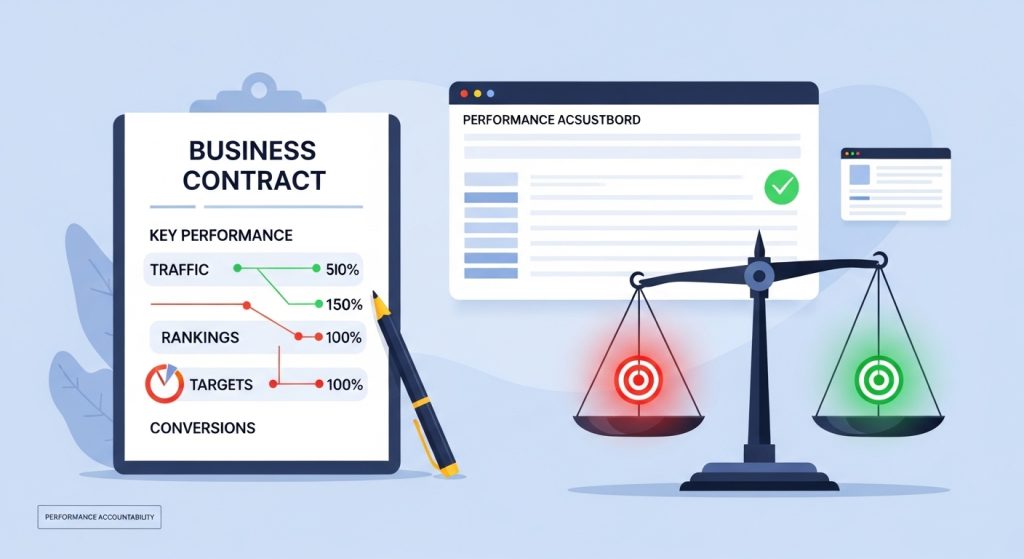
A proper performance accountability clause specifies the KPIs being tracked, the measurement tools used, the baseline starting point, the target range for 6 months, and what happens if results are significantly below target. Options include a mandatory strategy review, a temporary rate reduction, or a right to exit without the standard notice period.
Agencies will push back on this because it creates accountability beyond delivering the tasks listed in the scope of work. But accountability for outcomes, not just activities, is a reasonable thing to ask for in a relationship that costs thousands of dollars per month.
A Sub-Contracting Disclosure Requirement
If any part of the work will be outsourced to a third-party provider, you have the right to know. This includes content writing outsourced to freelancers, link building delegated to a link network, or technical work sent to an offshore team.
The disclosure clause should state that the agency will inform you in writing if any deliverables are subcontracted, identify the category of work being outsourced, and confirm that the subcontractor is bound by the same quality standards as the agency itself.
Without this clause, you can be paying agency rates for work produced by the cheapest available provider, with no quality control and no visibility into who is actually working on your site.
A Google Penalty Liability Clause
This is the clause that no competitor article mentions, and it is one of the most important for clients to request.
If an agency’s link-building tactics violate Google’s Webmaster Guidelines and trigger a manual action or algorithmic penalty, the consequences fall on your site: lost rankings, lost traffic, lost revenue. Recovery from a Google manual action typically takes 6 to 12 months after the bad links are disavowed and a reconsideration request is approved.
The contract should specify that if a penalty is directly caused by the agency’s tactics, the agency is responsible for remediation: identifying the bad links, submitting the disavow file, managing the reconsideration request, and doing this work at no additional charge. This clause will not be in the agency’s default template. You need to ask for it.
A 30 to 60 Day Exit Notice Period
A fair exit clause for a monthly retainer is 30 days’ written notice. Some agencies accept 60 days, which is reasonable for complex campaigns where a smooth transition takes time. Anything beyond 60 days, particularly on a first engagement, is excessive and favors the agency.
The notice period should specify how the final billing cycle works: do you pay for the full 30 or 60 days even if no work is being done, or does billing end when the notice is submitted? Also, confirm that all account access transfers to you within a defined number of business days after the relationship ends.
Clauses to Push Back On or Reject
Any Ranking Guarantee Language
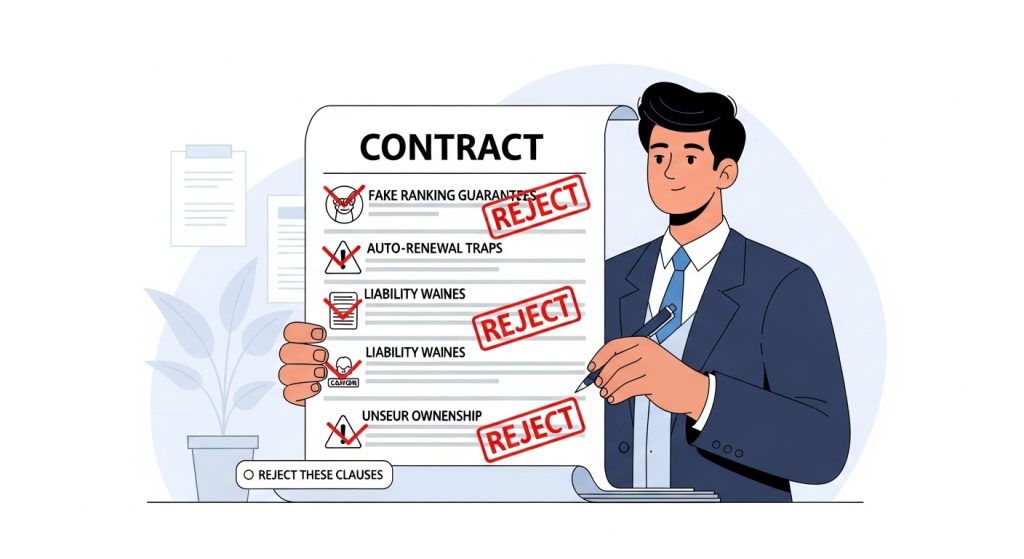
If a contract includes a guarantee of specific rankings or traffic volumes within a set timeframe, reject it. Either the clause is meaningless marketing language, or it signals that the agency plans to use tactics that violate search engine guidelines to deliver the promised result.
Google’s algorithm involves hundreds of ranking factors and updates continuously. No agency controls it. A contract with a ranking guarantee is written to impress during the signing stage, not to hold up under scrutiny.
What the contract should say instead is that the agency will apply best-practice SEO methods, deliver the specified work items, and measure performance against agreed KPIs. That is an honest commitment. A specific ranking promise is not.
Automatic Renewal Clauses Without a Cancellation Window
Some contracts automatically renew for another full term at the end of the initial period unless you give notice within a specific window, often 30 or 60 days before the renewal date. If you miss that window, you are locked in for another full term.
Push back on this in two ways. First, require that the agency send written notification at least 30 days before the renewal window opens, reminding you that action is required if you do not wish to renew. Second, negotiate the notice window to be as wide as possible. A 90-day renewal notice requirement on a 12-month contract means you need to decide whether to renew three months before the contract ends.
Liability Waivers That Remove All Agency Accountability
A limitation of liability clause is standard in service contracts. It typically caps the agency’s liability at the total fees paid in the preceding 3 to 12 months. That is reasonable.
What is not reasonable is a clause that removes liability for any outcome, including outcomes directly caused by the agency’s own tactics. Watch for language like “the agency is not responsible for any changes in search engine rankings, traffic, or revenue.” In isolation, this makes sense because SEO results are not fully in anyone’s control. But combined with no performance accountability clause and no penalty liability clause, it creates a contract where the agency can do almost anything and bear no consequence.
Vague or Missing Intellectual Property Ownership
Some contracts are silent on who owns the work produced. Others include language that grants the agency a license to use work produced for your site in their portfolio, case studies, or marketing materials. Portfolio rights are common and generally acceptable, but the clause should be specific about what can be shared and require your approval if any confidential business information is included.
What to reject: any language suggesting the agency retains co-ownership of content produced for your site, or that you cannot use the content with another provider if you leave.
Non-Solicitation Clauses That Are Too Broad
Some agencies include non-solicitation clauses that prevent you from hiring their employees or contractors directly for a period after the contract ends, often 12 to 24 months. Narrow non-solicitation terms are standard practice. But watch for clauses written so broadly that they restrict your ability to hire anyone in the digital marketing field, or that list vague categories of “affiliated contractors.”
Negotiate this down to a specific list of named individuals if it is included at all.
Fair vs. Agency-Biased Contract Language: A Direct Comparison
| Clause | Client-Favorable Version | Agency-Favorable (Trap) Version |
| Scope of Work | “Agency will deliver 4 blog posts, 3 to 5 backlinks, and 1 monthly report each month.” | “Agency will provide ongoing SEO services as appropriate.” |
| Exit Terms | “Either party may terminate with 30 days’ written notice.” | “Client may terminate with 90 days’ notice; fees continue during notice period.” |
| Data Ownership | “Client holds primary admin ownership of all digital accounts.” | “Agency manages all campaign tools and dashboards on the client’s behalf.” |
| Liability | “Agency liable for penalties caused directly by its own link-building tactics.” | “Agency not responsible for any changes in rankings, traffic, or revenue.” |
| IP Ownership | “All content belongs to the client upon full payment.” | “Agency retains license to content for portfolio and promotional use.” |
| Auto-Renewal | “Agency notifies client 45 days before renewal window; client may cancel anytime.” | “Contract renews automatically unless cancelled 60 days before term end.” |
| Performance | “Strategy review required if organic traffic declines 20%+ for 2 consecutive months.” | No performance accountability clause included |
Contract Types and Which Clauses Matter Most for Each
| Contract Type | Most Critical Clauses | Watch Out For |
| Monthly retainer | Exit terms, deliverables, and performance accountability | Vague scope, auto-renewal, no accountability |
| Project-based | Specific deliverables, payment milestones, kill fee | Scope creep, upfront-heavy payment |
| Performance-based | Baseline metrics, measurement tools, and dispute resolution | Undefined KPIs, cherry-picked metrics |
| White-label | Sub-contracting disclosure, data ownership | No visibility into who does the work |
What to Do If the Agency Will Not Negotiate
Professional agencies expect clients to read contracts carefully and ask questions. If an agency tells you the contract is non-negotiable on every point, that itself tells you something about how the relationship will go when problems arise.
There are a few realistic outcomes when you try to negotiate:
- Some agencies will not adjust specific clauses for legal or policy reasons but will agree to written side commitments that address your concern. For example, they may not change the liability clause template, but will confirm in an email that they are responsible for any penalties arising from their link building. Get that in writing.
- Some agencies will readily negotiate specific terms. Exit notice periods and deliverable specifics are the most commonly adjusted items. Payment milestones on project work are also frequently open to negotiation.
- If an agency is unwilling to name specific monthly deliverables, refuses to confirm data ownership, or insists on a 90-day exit clause with no accountability provisions, those are legitimate reasons to choose a different agency. The contract is not a sales document. It is a protection document. An agency that does not want you protected is not an agency that wants a fair partnership.
Pre-Signing Checklist: 12 Things to Verify Before You Sign
Go through this list before signing any SEO service agreement:

- Monthly deliverables are specifically named with quantities and quality standards
- You are confirmed as the primary admin owner of all digital accounts in writing
- The exit notice period is 30 to 60 days maximum
- There is no automatic renewal without written notification from the agency
- The limitation of liability clause is reasonable and does not remove all agency accountability
- All content and work product belong to you upon full payment
- Sub-contracting disclosure is required if any work is outsourced
- A performance accountability mechanism is included for sustained underperformance
- The confidentiality clause protects your business information during and after the engagement
- No ranking guarantees are present in the contract
- The governing law and dispute resolution process are clearly specified
- The penalty liability clause addresses what happens if the agency’s tactics cause a Google manual action
Frequently Asked Questions About SEO Agency Contracts
How long should an SEO agency contract be?
For a first engagement, 3 to 6 months is reasonable. This is long enough for early indicators of performance to appear, but short enough that you are not locked in for a year without evidence of progress. If the agency insists on a 12-month minimum, negotiate a performance review clause at the 3-month mark that gives you an exit right if specific conditions are not met.
What should the payment terms look like in an SEO contract?
Monthly retainers are typically billed monthly in advance or on a net-15 basis. Avoid contracts that require a large upfront payment covering multiple months of work. If a significant upfront payment is requested for setup or onboarding, it should be tied to a specific deliverable such as a technical audit or initial keyword strategy, not paid as a general retainer.
Who owns the content an SEO agency creates for my site?
You should. Any content produced for your website, including blog posts, landing pages, and meta descriptions, should transfer to your ownership upon full payment. This should be stated explicitly in the contract. The agency may retain the right to reference the work in their portfolio, but they should not retain co-ownership or any rights to restrict your use of the content.
What is a scope creep clause, and why does it matter?
Scope creep happens when the agency performs work beyond the original agreement and then invoices for it without prior approval. A scope creep clause specifies that any work outside the agreed deliverables requires written approval from you before it is performed, and that the rate for out-of-scope work is agreed in advance. Without this clause, surprise invoices at month-end are a real risk.
Can I negotiate an SEO agency contract?
Yes, and you should. Specific deliverables, exit notice periods, payment milestones, and data ownership terms are regularly negotiated. If an agency tells you the entire contract is non-negotiable, treat that as a signal about how they will handle disputes once you are a client.
What should the contract say about Google algorithm updates?
The contract should acknowledge that search rankings are subject to factors outside the agency’s control, including Google algorithm updates. It should also specify how the agency communicates when updates occur, what their process is for assessing impact on your site, and whether a strategy review is triggered if traffic drops significantly following an update.
Conclusion
An SEO contract protects you when things do not go as planned. The scope of work, data ownership, exit terms, and performance accountability clauses are the four areas where most clients get caught out. Read every clause before signing, compare the language against the fair vs. biased examples in this guide, and use the pre-signing checklist to confirm every protection is in place.
Agencies listed on platforms like Top SEO Agencies tend to be more transparent about contract terms because their reputation is publicly visible. That transparency is worth looking for before you negotiate.
Browse verified SEO agencies at Top SEO Agencies