
Hiring the wrong SEO agency does not just waste money. It can actively damage your website’s search performance in ways that take 6 to 18 months to repair. Google manual penalties, spammy backlink profiles, and thin AI-generated content are all common consequences of working with the wrong team.
The problem is that most of these agencies are good at selling. They use confident language, polished decks, and impressive-sounding claims. If you do not know what to look for, it is easy to miss the warning signs until you are already locked into a contract. This is why working with a transparent, data-driven agency like Wiserank can make a measurable difference from the start.
This article covers 12 specific red flags across three stages: before you get on a call, during the sales process, and after you have already signed. Most articles only cover the first stage. That leaves buyers unprepared for the warning signs that appear once the work has actually started.
Why Most Business Owners Get Burned by Bad SEO Agencies
The SEO industry has no universal licensing requirement. Anyone can call themselves an SEO agency and start pitching clients. That reality, combined with the fact that SEO results take months to materialize, creates the perfect conditions for underperforming agencies to collect fees for a long time before clients realize nothing is working.
Before you contact any agency, you can do independent verification that most buyers skip. Run the agency’s domain through Ahrefs or SEMrush. Do they rank for relevant industry terms? An agency with no organic visibility of its own raises an immediate question about credibility. Read their reviews on Clutch and Google Reviews, but go beyond the star rating. Read the 3-star and 4-star reviews closely. Those tend to contain the most useful information about where an agency falls short.
This baseline research takes about 30 minutes per agency and changes the entire dynamic of the sales conversation.
Red Flags Before the Call Even Starts
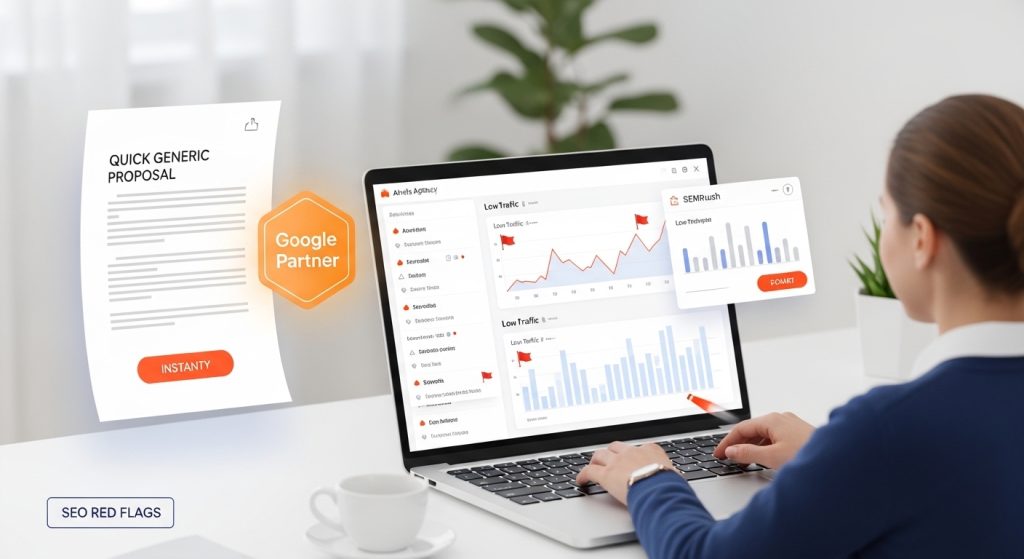
Red Flag 1: Their Own Website Has No Organic Presence
The simplest test of whether an SEO agency can do what they claim is whether they have done it for themselves. Open Ahrefs or SEMrush, run a free domain check on the agency’s website, and look at their organic traffic and keyword rankings.
If an agency that charges $3,000 a month for SEO services gets fewer than 500 organic visitors per month on their own site, or ranks for nothing competitive in their own industry, that is worth questioning directly.
Some agencies will say they focus all their resources on client work rather than their own marketing. That can be true for very small boutique teams. But if you cannot see any evidence that they understand how to grow organic traffic on a real website, you have no external proof that their approach works.
What to do: Run their domain through a free tool before your first call. Come prepared with the data.
Red Flag 2: The Proposal Arrives Within Hours of Your First Conversation
A genuine SEO proposal requires understanding your website, your competitors, your industry, and your business goals. That takes time. If an agency sends you a polished proposal within 12 to 24 hours of your first contact, without a substantive discovery call, it is almost certainly a template with your company name inserted.
Template proposals look thorough because they are long. They describe services in general terms, include pricing tiers, and sound professional. But they contain nothing specific to your situation. They do not reference your current organic traffic, your competitors, or why certain keyword targets make sense for your business specifically.
A proposal built around your actual situation takes at least a few days to assemble after a proper discovery conversation. Agencies that skip this step are signaling how they will approach your work: quickly, generically, and without the research that leads to real results.
What to do: If a proposal arrives suspiciously fast, send back a specific question about your competitive landscape. See if the answer is specific or generic.
Red Flag 3: They Claim to Be a Google Partner as Proof of SEO Expertise
Some agencies lead with “Google Certified” or “Google Partner” status as a signal that they have special access to the algorithm or inside knowledge of how rankings work. This is misleading in a very specific way.
Google Partner status is a certification related to Google Ads spend and campaign performance. It has nothing to do with organic search or SEO capability. A Google Partner badge means an agency manages paid search campaigns at a certain volume, not that they understand how to rank websites organically.
No company outside Google has privileged access to the search algorithm. Any agency that implies otherwise is either confused about what their certification means or is intentionally using it to mislead buyers.
What to do: If an agency uses Google Partner status to justify their SEO credibility, ask them to clarify what the certification actually covers. Their answer will tell you how transparent they are willing to be.
Red Flags During the Sales Process
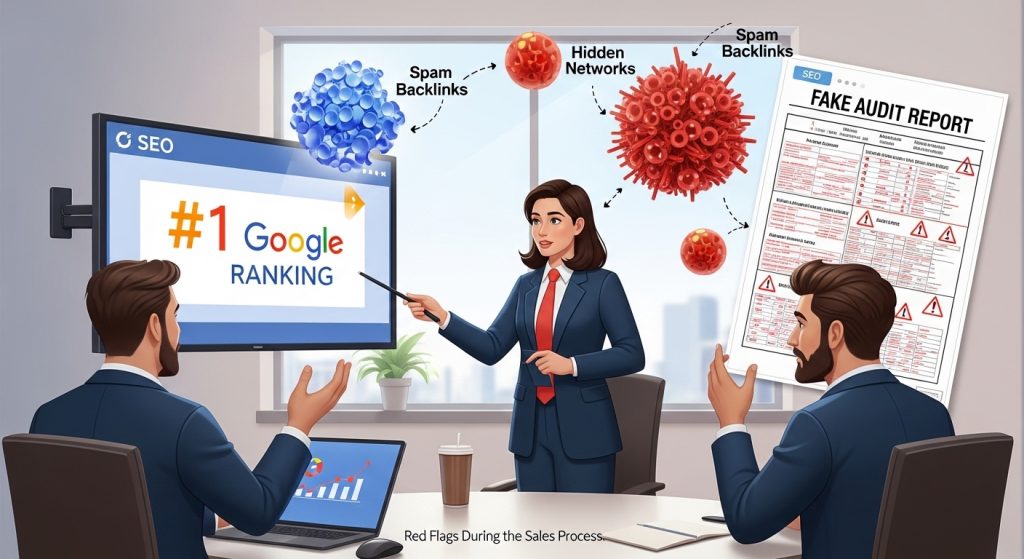
Red Flag 4: They Guarantee Specific Rankings or Traffic Numbers
This is the oldest red flag in SEO and still the most common. No agency can guarantee specific rankings because Google’s algorithm is constantly changing, and competitors are always improving. Promises like “#1 on Google” usually mean risky tactics or low-value keywords.
According to Google guidelines, manipulative practices like link schemes or keyword stuffing can lead to penalties that take months to recover from.
A trustworthy agency focuses on real deliverables, quality content, technical improvements, and earned backlinks—while giving realistic growth estimates, not fake guarantees.
What to do: If a guarantee is offered, ask what happens contractually if the promised ranking is not achieved. Watch what they say.
Red Flag 5: They Are Vague or Secretive About Their Link Building Process
Link building is the area where the most damage is done to websites that hire underperforming agencies. Low-quality backlinks from irrelevant directories, foreign-language sites, and private blog networks can trigger a Google algorithmic penalty or manual action that takes over a year to recover from.
Real link building is slow and earned through outreach, valuable content, and placements on relevant sites. A solid agency might build a handful of high-quality links each month, not dozens overnight.
If an agency promises 50–100 links monthly or calls their process “proprietary” without explanation, that’s a major red flag. Transparent agencies explain how they earn links—because they have nothing to hide.
The comparison below shows the difference:
| Legitimate Link Building | Red Flag Link Building |
| Earned through editorial outreach | Purchased through link networks |
| 3 to 10 high-quality links per month | 50 to 100+ links per month promised |
| Links from relevant, real publications | Links from directories, foreign sites, PBNs |
| Can name specific sites targeted | “Proprietary network” or refuses to explain |
| Sustainable long-term | Risks Google manual action |
What to do: Ask them directly: “Can you give me an example of a site you recently earned a link from for a client, and what content was used?” A legitimate agency can answer that question specifically.
Red Flag 6: The Automated Audit Used as a Scare Tactic
This one is less commonly discussed but very common in practice. A business owner receives a 40-page site audit within 24 hours of their first inquiry. Every item is flagged red. The document looks alarming and professional. The salesperson uses it to explain why the site needs “urgent” fixes.
These reports often highlight minor issues like meta descriptions or alt tags. While valid, they rarely impact rankings in a meaningful way. A real audit goes deeper, focusing on crawl issues, indexing problems, site performance, and internal linking gaps that actually affect SEO.
If everything is marked “critical” without clear prioritization, it’s not a strategy, it’s a sales tactic.
What to do: If you receive an unsolicited audit, ask the agency which 3 items in the report will have the biggest impact on your organic traffic and why. If they cannot answer specifically, the audit was designed to impress, not inform.
Red Flag 7: They Show You Rankings Without Traffic or Conversion Context
Ranking improvements alone don’t mean real results. Moving from position 15 to 4 sounds good—but if the keyword has low search volume or poor intent, it won’t impact your business.
Some agencies cherry-pick easy, low-competition keywords just to show “wins.” That’s not growth—it’s optics. What actually matters is organic traffic and conversions. Ask for case studies that show:
- Traffic growth
- Leads or revenue generated
- Conversion impact
Strong agencies can connect SEO work to real business outcomes. If they keep steering back to rankings only, that’s a red flag.
What to do: When reviewing case studies, ask: “What was the monthly organic traffic before and after this work?” Then, verify the numbers by running the client’s domain through Ahrefs.
Red Flag 8: No Clear Answer on Who Will Actually Work on Your Account
This happens in two ways. The first is that the agency pitches senior strategists during the sales process and then hands the account to a junior team once the contract is signed. The second is that the account is quietly outsourced to a third-party provider in another country at a significantly lower cost, with the agency pocketing the margin.
Both situations produce the same outcome: the people actually working on your account have less experience, less context, and less investment in your results than the people who sold you the service.
Before signing, ask: “Who specifically will work on my account, and what is their background?” Then ask: “Does any part of the work get outsourced to third-party providers?” If they hesitate or give vague answers about a “team,” push for names and roles.
What to do: After signing, request an introduction email that names every person working on your account and their specific responsibilities. This creates accountability from day one.
Red Flags You Notice After Signing (Most Articles Never Cover These)
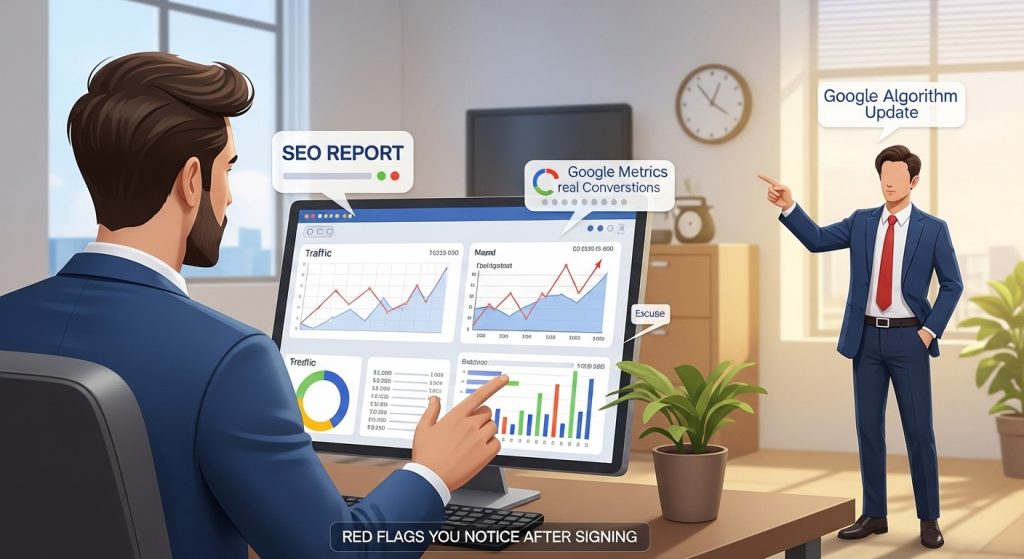
Red Flag 9: Reports Arrive Without Explanation or Context
Once work is underway, monthly reports become your window into what is actually happening. A report that just shows a table of keyword rankings, a screenshot of Google Analytics traffic, and a list of tasks completed without any explanation is not a report. It is a document.
Good monthly reports explain why metrics moved the way they did. If organic traffic dropped 12 percent in March, the report should address it: Was there an algorithm update? Did a key page lose rankings? Is this a seasonal pattern? What is the plan to recover?
An agency that sends the same formatted report every month without any strategic commentary is either not analyzing the data or not confident in what the data shows.
What to do: After receiving your first report, reply with a specific question: “Organic traffic was down 8 percent this month. What drove that, and what is the plan?” The quality and speed of the response tells you how informed and accountable the team is.
Red Flag 10: Excuses Are Always Tied to Algorithm Updates
Some traffic fluctuation is normal after any Google core update. But a pattern of blaming every flat or negative result on algorithm updates, without a specific explanation of what changed and why it affected your site, is a way of avoiding accountability.
Algorithm updates affect all sites, but they do not affect all sites equally. Sites with strong topical authority, good technical health, and genuine content tend to hold their positions better through updates. If your site consistently underperforms after updates while competitors in the same space recover, the issue is likely the strategy, not the update.
A transparent agency monitors updates in real time using tools like SEMrush Sensor or Google Search Console performance reports, communicates proactively when they see unusual movement, and explains what specifically on your site was affected and why.
What to do: If algorithm updates are used to explain poor performance more than once without specific analysis, ask for a side-by-side comparison of your site’s performance against 3 competitors in the same period. If competitors recovered and you did not, the strategy needs to change.
Red Flag 11: You Are Reporting Vanity Metrics Instead of Business Metrics
There is a meaningful difference between metrics that look good and metrics that tell you whether SEO is working for your business.
Vanity metrics: total organic sessions, average domain authority score, total number of keywords ranking, and raw number of backlinks acquired.
Business metrics: organic traffic to product or service pages specifically, conversion rate from organic visitors, leads, or revenue attributed to organic search, and click-through rate on commercial keywords.
An agency that shows you a dashboard full of upward-trending charts while your actual sales from organic remain flat is optimizing the wrong things. It is possible to grow total organic traffic substantially by targeting informational keywords with no purchase intent while commercial pages stagnate.
| Vanity Metric | What It Tells You | Business Metric | What It Actually Shows |
| Total organic sessions | Volume only | Organic sessions to key pages | Whether the right people are landing |
| Domain Authority score | Third-party estimate | Ranking position on commercial terms | Visibility where it matters |
| Total keywords ranking | Quantity only | Conversion rate from organic | Whether traffic becomes customers |
| Number of backlinks | Volume only | Revenue influenced by organic | Business impact |
What to do: Ask your agency to add a “conversions from organic” segment to your monthly reporting. If they cannot or will not, your reporting is missing what matters most.
Red Flag 12: The Agency Has No Strategy for AI Search Visibility
This is the red flag that virtually no competitor article in this space addresses, and it is the one most relevant to 2026. Google AI Overviews now appear at the top of a large portion of informational and commercial queries. ChatGPT, Perplexity, and other AI tools are being used for search-like tasks daily by hundreds of millions of people worldwide.
An agency that has no understanding of how content gets featured in AI-generated answers is optimizing for a version of search that no longer exists in its pure form. Generative Engine Optimization (GEO) and Answer Engine Optimization (AEO) are now real disciplines alongside traditional SEO. They involve writing content with clear, direct answers to specific questions, building topical authority through content clusters, using structured data markup, and ensuring content is accessible to crawlers used by AI systems.
If you ask an agency how they approach AI search visibility and they either have no answer or dismiss it as not relevant, they are working with an outdated model of how organic visibility actually functions.
What to do: Ask directly: “How do you approach content to improve visibility in Google AI Overviews and other AI-generated answers?” A capable agency in 2026 will have a clear answer. An agency still thinking only in terms of blue-link rankings will not.
Red Flag Severity Guide: Which Warning Signs Are Deal-Breakers
Not every red flag carries the same weight. Some are immediate grounds to walk away. Others are serious concerns worth discussing. A few are minor issues that may have reasonable explanations.
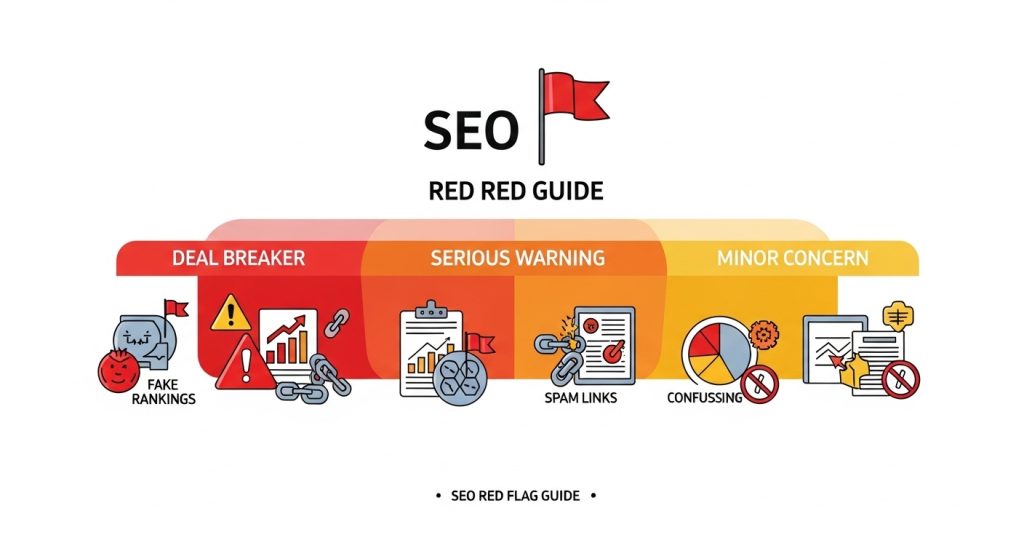
| Automated audit used as a scare tactic | Severity | Why |
| Guaranteed specific rankings | Deal-breaker | Either dishonest or planning black hat tactics |
| Secretive about link building | Deal-breaker | Almost always means low-quality or paid links |
| No data ownership for you | Deal-breaker | You can lose your entire performance history |
| No accountability for zero results | Deal-breaker | No protection if work fails |
| Automated audit used as scare tactic | Serious warning | Designed to manipulate, not inform |
| Proposal arrives within hours | Serious warning | Template work, no real research |
| Case studies show only rankings | Serious warning | Missing the business impact evidence |
| Vague reporting with no context | Serious warning | No transparency into what is happening |
| Algorithm updates blamed constantly | Serious warning | Sign of poor strategy or avoidance |
| Vanity metrics in reporting | Serious warning | Optimizing for appearances, not results |
| Google Partner badge used for SEO credibility | Minor concern | Outdated approach in the 2026 context |
| No AI search visibility strategy | Serious warning | Outdated approach in 2026 context |
What to Do If You Have Already Signed and Are Seeing These Signs
Most articles stop before this section. Here is what to actually do if you are in a contract with an agency showing these warning signs.
Step 1: Request a full account access audit. Confirm that you are the primary owner of Google Analytics, Google Search Console, Google Tag Manager, and any other accounts the agency manages on your behalf. If you are not, change this immediately.
Step 2: Pull your own baseline data. Open Google Search Console and look at organic clicks and impressions over the last 6 months. Compare against your first month with the agency. If clicks and impressions on commercial pages have not grown, note that specifically.
Step 3: Ask for a written deliverables audit. Request a list of every deliverable completed in the last 3 months against what was promised in the contract. Present this in writing, not on a call.
Step 4: Review the contract exit clause. Most contracts require 30 to 60 days’ written notice. Send notice in writing if you decide to leave. Do not stop payment without notifying them formally first.
Step 5: Before leaving, secure all your assets. Download all reports, export Google Analytics data, ensure you have admin access to all accounts, and make a copy of all content produced for your site.
Frequently Asked Questions About SEO Agency Red Flags
What is the single biggest red flag when hiring an SEO agency?
A guarantee of specific rankings is the clearest signal that something is wrong. No ethical SEO professional makes this promise because no one controls Google’s algorithm. The only agencies that guarantee rankings plan to achieve them through methods that violate Google’s guidelines, which creates long-term risk for your site.
How do I check if an SEO agency is actually good at SEO before hiring them?
Run their domain through a free Ahrefs or SEMrush website check. See if they rank for meaningful keywords in their own industry. Read their reviews on Clutch and Google Reviews and look for patterns in complaints. Ask for case studies and verify the traffic claims by checking the client’s domain independently through the same tools.
Can a Google penalty really last that long, and how does it happen?
Yes. A Google manual action for link spam can take 6 to 12 months to resolve after the issues are corrected and a reconsideration request is submitted. Algorithmic penalties tied to core updates can persist until the next core update rolls out, which Google now runs on an irregular schedule. The penalty is usually caused by a previous agency’s link-building tactics: paid links, private blog networks, or irrelevant directory submissions.
What should I do if I am already in a bad agency contract?
Secure your account ownership first. Make sure you control Google Analytics, Google Search Console, and Google Tag Manager as the primary owner. Then review the contract exit clause, send formal written notice if you decide to leave, and download all your data before the relationship ends. Do not rely on the agency to transfer this to you cleanly after the relationship has soured.
Is it a red flag if an SEO agency does not discuss AI search at all?
In 2026, yes. Google AI Overviews now appear on a significant portion of queries. If an agency has no strategy for how their content works to improve your visibility in AI-generated answers, they are optimizing for a narrower version of search than what currently exists. It does not mean they are fraudulent, but it does mean their approach is incomplete.
How many links per month should a legitimate agency be building?
A realistic number for a mid-size business is 3 to 10 high-quality backlinks per month through editorial outreach. Any agency promising 50 to 100 links per month at a reasonable price is almost certainly using low-quality link networks. More links is not better if the links come from irrelevant or low-authority sources.
Conclusion
The 12 red flags in this article fall into 3 clear stages: before the call, during the pitch, and after you have signed. Most buyers only protect themselves in the first stage. The warning signs that appear after a contract is signed are often the most costly to ignore because they are harder to exit.The agencies worth hiring will welcome scrutiny at every stage. Use Ahrefs and SEMrush to verify their organic credibility before you call. Ask specific questions during the pitch that expose how they actually work. And once you are a client, request reporting that goes beyond rankings and sessions to show real business impact. Directories like Top SEO Agencies make this process easier by listing verified agencies with independent reviews and transparent specializations.