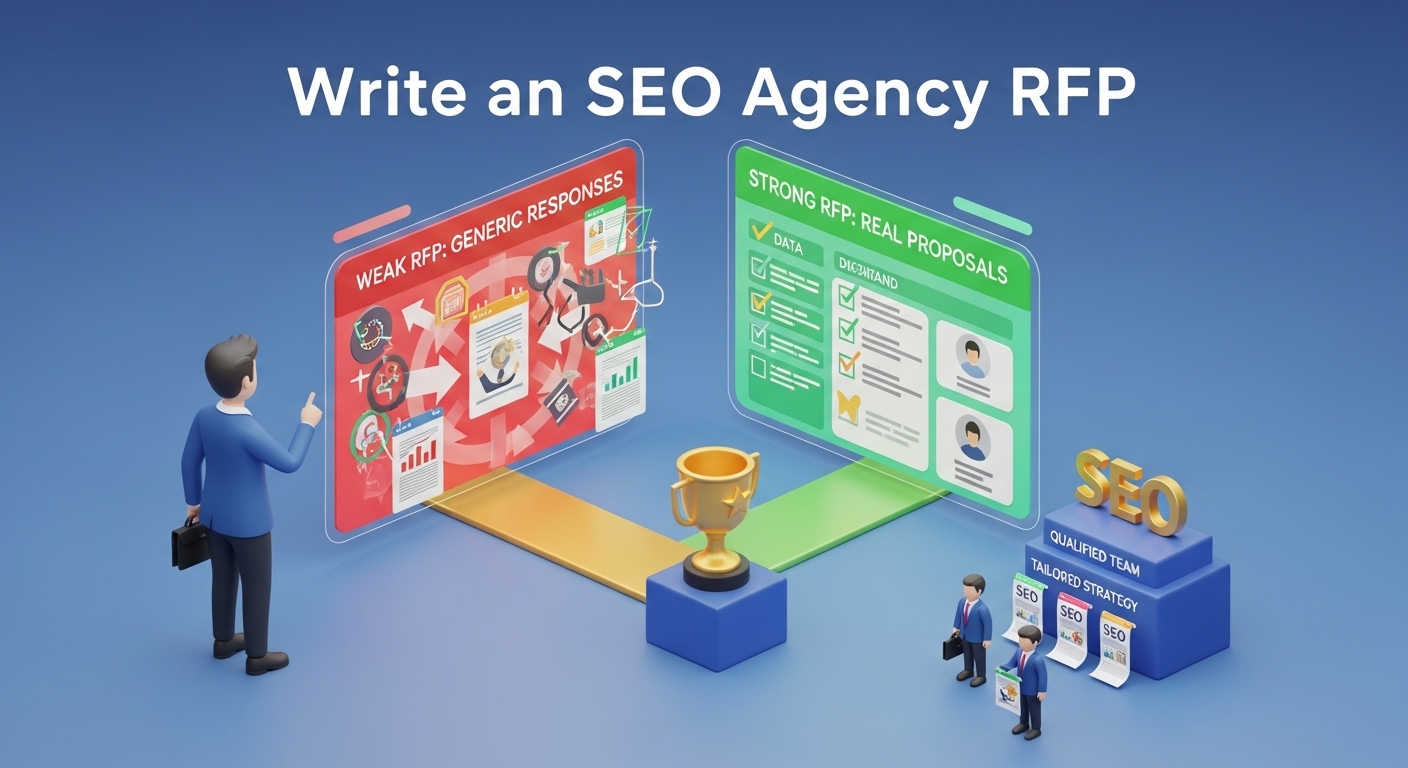
Most SEO agency RFPs do the opposite of what they are supposed to do. They are either so vague that agencies send back generic template responses, or so long and bureaucratic that the best agencies decline to respond entirely.
A Request for Proposal is a document that describes your Search Engine Optimization needs and invites agencies to explain how they would approach your specific situation. When written well, it filters out weak agencies, attracts serious ones, and gives you enough comparable information to make a genuinely informed hiring decision.
This guide walks through every section your RFP needs, what to put in each section, the mistakes that cause good agencies to disengage, and a scoring framework for evaluating the proposals you receive.
Why Most SEO RFPs Fail to Attract the Right Agencies
Before building the document, it is worth understanding why so many RFPs produce disappointing results.

The agencies most worth hiring are busy. They have more incoming inquiries than they can serve. When a long, vague RFP lands in their inbox, they make a quick assessment: Is responding to this worth the time? If the RFP reads like a government procurement document, requires 40 pages of written responses for a $2,000 per month retainer, and gives them no real information about the business or its goals, experienced agencies often decline to bid.
At the same time, template-driven agencies that produce dozens of generic proposals per week respond to everything. The result is that poorly written RFPs attract the wrong agencies and filter out the right ones.
A good SEO RFP is specific enough to be worth responding to, concise enough to respect the agency’s time, and informative enough for a capable agency to produce a proposal that reflects actual strategic thinking about your situation.
What to Do Before You Write the RFP
The most important preparation for writing an SEO RFP happens before you open a document.
Define Your Goals in Business Terms, Not SEO Terms
Agencies can work toward keyword rankings, organic traffic, or any number of technical improvements. What actually matters to your business is what happens downstream: more qualified leads, more online sales, more bookings, more brand visibility in a specific market.
Before writing the RFP, document what success looks like in 12 months using business outcomes:
- “We want 30% more qualified leads per month from Organic Search within 12 months.”
- “We want to rank on page 1 for 5 core commercial keywords in our industry within 9 months.”
- “We want to grow organic revenue from $40,000 to $70,000 per month within 18 months.”
These goal statements are far more useful to a serious agency than “we want to improve our SEO.”
Gather Your Current Baseline Data
A capable SEO agency needs to understand where you are starting from before they can propose where they will take you. Before writing the RFP, pull this data and include it in your document:
- Current monthly organic traffic from Google Analytics
- Current keyword rankings for your top 10 target terms from Google Search Console
- Domain Authority score from a tool like Ahrefs or SEMrush
- Number of indexed pages and any known technical issues
- Backlinks profile summary: number of referring domains and any known spam or penalty history
Sharing this information signals to serious agencies that you are prepared, which makes them more likely to invest time in a detailed proposal.
Know Your Budget Range Before Asking
The most common mistake business owners make in RFPs is refusing to share their budget. The reasoning is usually: “If I tell them the budget, they will just price up to it.”
In practice, the opposite problem is more common. An agency that does not know your budget cannot tell you whether they can serve you or what they would do with that investment. They either underprice and over-promise to win the business, or overprice and lose it unnecessarily.
Include a budget range in your RFP. Being specific in an honest range (for example, “$3,000 to $5,000 per month”) attracts agencies that can realistically deliver within that range and saves everyone time.
The 8 Sections Every SEO Agency RFP Needs

Section 1: Company Overview and Business Context
This section introduces your business to the agency. Do not assume they know who you are. Include:
- What your business does and who your customers are
- Your primary market: local, national, or international
- Your revenue model: e-commerce, lead generation, subscriptions, or services
- Key competitors, you are aware of
- Any previous SEO work, and why you are looking for a new provider, if applicable
This section should be 200 to 300 words. Its purpose is to give the agency enough context to start thinking about your situation specifically, rather than applying a template.
Section 2: Project Scope and Goals
State what you need done and what you want to achieve. Be specific about:
- Which services you need: Technical SEO audit, Content Marketing, Link Building, Keyword Research, reporting setup, or a combination
- Your primary business goal tied to Organic Search (defined in business terms, as above)
- Any specific constraints: existing CMS, development team capacity, content approval process
- Whether this is a one-time project or an ongoing retainer engagement
Section 3: Current State of Your SEO
Share your baseline data here. Include your current organic traffic figures from Google Analytics, your Google Search Console performance overview, your Domain Authority, and a summary of known issues. If you have had a previous agency and experienced specific problems such as a Google penalty, declining traffic after an algorithm update, or a migration that went wrong, include that context.
This section is where most business owners hold back. Sharing current performance honestly actually helps you, because it allows agencies to propose a genuinely appropriate strategy rather than guessing.
Section 4: Your Target Audience and Competitive Landscape
A Digital Marketing Strategy cannot be built without understanding the audience and the competitive environment. Include:
- A description of your primary customer: industry, role, geography, search behavior
- 3 to 5 direct competitors who you believe are performing well in Organic Search
- Any high-priority keywords or keyword clusters you already know about
- Industries or topic areas where you have existing content or expertise
This allows agencies to do a quick competitive analysis before proposing rather than relying entirely on assumptions.
Section 5: Scope of Required Services
Be explicit about what you need. Use clear language rather than umbrella terms. Instead of “we need SEO,” specify:
- Full Technical SEO audit and implementation roadmap
- Keyword Research for 3 core service areas
- Monthly content production: number of pieces, approximate word count, topic areas
- Link Building: a defined monthly target or approach
- Monthly reporting using Google Search Console and Google Analytics
- Strategy reviews: frequency and format
If you are unsure of the scope, say so and ask agencies to recommend what they believe is appropriate based on your goals and budget. That is legitimate, and any good agency will respond to it specifically.
Section 6: Proposal Requirements
This section tells agencies exactly what you want them to include in their response. The more specific you are here, the more useful and comparable the responses will be.
Ask for:
- Their proposed approach and strategy for your specific situation (not a general overview of their services)
- The team structure: who would work on your account and in what roles
- Monthly deliverables: what you would receive each month
- Reporting structure: what data they track, what tools they use (Google Analytics, Google Search Console, third-party rank tracking), and how frequently
- 2 to 3 relevant case studies with specific results: organic traffic change, keyword movement, time to results
- Pricing structure: monthly retainer, project-based, or performance-based, and what is included
- Contract terms: minimum engagement length, exit notice period, data ownership
- References: 1 to 2 clients who are willing for you to contact directly
Section 7: Timeline and Process
Tell agencies when you want proposals back and what your decision timeline looks like. Include:
- RFP submission deadline
- Your expected decision date
- Whether you plan to hold follow-up calls with shortlisted agencies
- Expected start date for the engagement
A clear timeline shows agencies that you are a serious buyer with a real decision to make, which increases response rates from the best providers.
Section 8: Evaluation Criteria
Tell agencies how you will score their proposals. This is transparent and professional, and it signals that you are evaluating based on substance rather than price alone.
A useful scoring framework for an SEO agency proposal looks like this:
| Evaluation Criterion | Weight |
| Strategic understanding of your specific situation | 30% |
| Quality and relevance of case studies | 20% |
| Team structure and account management approach | 20% |
| Pricing relative to scope and deliverables | 15% |
| Reporting transparency and measurement approach | 10% |
| Contract flexibility and exit terms | 5% |
Sharing this with agencies gives them a target to aim at. It also helps you evaluate responses consistently rather than making decisions based on which proposal looked most polished.
What a Weak RFP Looks Like vs. a Strong One
| Element | Weak RFP | Strong RFP |
| Company description | “We are a growing company looking to improve our SEO.” | 200 words: business model, customer profile, current revenue channel mix |
| Goals | “Increase organic traffic and rankings.” | “30% more leads from Organic Search within 12 months” |
| Budget | Not disclosed | “$3,000 to $5,000 per month retainer” |
| Baseline data | Not included | Current traffic, GSC performance, Domain Authority, Backlinks count |
| Scope | “Full SEO services” | Specific services listed: audit, content, Link Building, reporting |
| Proposal requirements | “Tell us about your approach.” | 8 named sections each agency must address |
| Evaluation criteria | Not mentioned | Weighted scoring table shared with agencies |
| Timeline | “ASAP” | Submission deadline, decision date, expected start date |
Common Mistakes That Cause Good Agencies to Not Respond
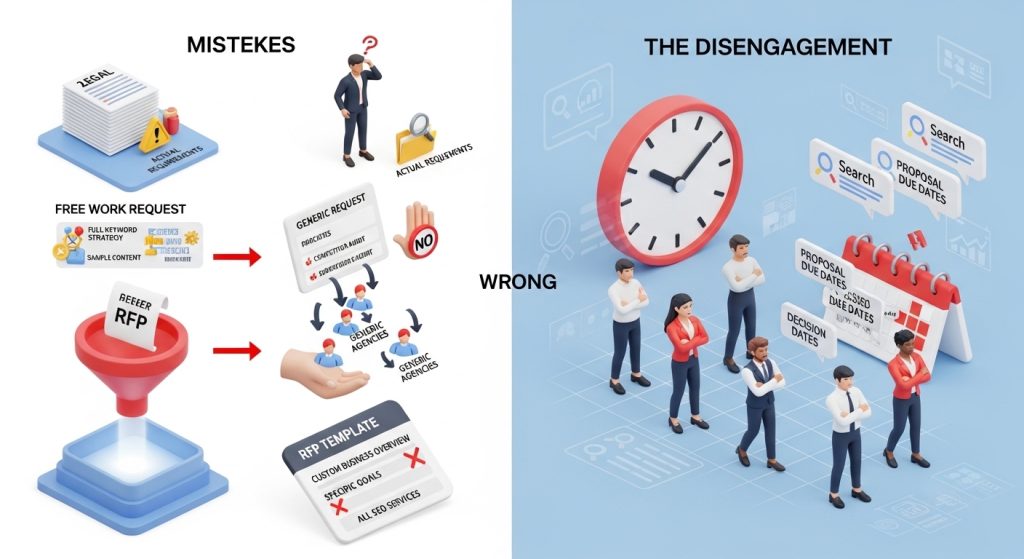
Making the RFP Too Long Without Providing Enough Information
A 20-page RFP with 15 pages of legal boilerplate and 5 pages of actual requirements sends the wrong signal. Agencies spend their proposal time on the business problem, not on your compliance requirements. Keep the document focused on the information they need and the questions you need answered.
Asking Agencies to Work for Free Before the Engagement Starts
Some RFPs request that agencies produce a full keyword strategy, conduct a competitor audit, or build a sample content plan as part of the proposal process. This is asking professional service providers to give away work they charge for. The agencies worth hiring will decline. The ones that comply may be doing it poorly just to win the work.
What you can reasonably ask for in a proposal: their strategic approach, case studies, team structure, pricing, and references. You cannot reasonably ask for unpaid work that would normally be billable.
Sending the RFP to Too Many Agencies at Once
Sending the same RFP to 20 agencies produces 20 generic responses. The better agencies know when they are one of many recipients and reduce the effort they invest accordingly. Target 4 to 6 agencies whose prior work, specialization, or client reviews suggest they are a genuine fit.
Use platforms like Top SEO Agencies to identify agencies with verified profiles and reviews before building your shortlist. This pre-vetting step means every agency on your list has a legitimate reason to be there.
Using a Template Without Customizing It
RFP templates are a useful starting point. They are not a finished document. Agencies can tell immediately when a template has been filled in with minimal thought. The company overview section is blank, the goals are copy-pasted generic language, and the scope says “all SEO services.” Customize every section with information specific to your business.
How to Evaluate Proposals After You Receive Them
When proposals come back, use your weighted scoring framework and look for these specific signals of quality.
Strategic Specificity
A strong proposal references details from your RFP throughout. It mentions your specific competitors, addresses your stated goals, and proposes a strategy that responds to your current baseline rather than describing the agency’s general capabilities. A generic proposal that could apply to any client is a sign that the agency either did not read your RFP carefully or is applying a template.
Case Study Relevance
Case studies should feature businesses with similar characteristics: similar size, similar industry, or similar starting baseline. A case study showing organic traffic growth from 5,000 to 50,000 monthly visitors is only meaningful if the timeline, methods, and starting conditions are comparable to yours.
Team Clarity
A quality proposal names the specific people who would work on your account, describes their roles, and confirms their availability. If a proposal says “our experienced team” without naming anyone, push back on this in a follow-up call.
Reporting Detail
Ask yourself: Does this proposal tell me exactly what data I would receive, from which tools, and how often? A proposal that commits to monthly reporting from Google Analytics and Google Search Console with a specific format is more accountable than one that promises “regular updates.”
FAQs About SEO Agency RFPs
Do I need an RFP to hire an SEO agency?
Not always. For smaller budgets or straightforward engagements, a direct conversation and a written proposal requested in a discovery call may be sufficient. An RFP is most useful when you are comparing multiple agencies simultaneously, when the budget is significant enough to justify the process, or when you have internal stakeholders who need documentation of the selection process.
How long should an SEO agency RFP be?
3 to 6 pages is appropriate for most businesses. Enough to give agencies real context and clear requirements without becoming a burden that discourages serious responses. Legal sections and boilerplate should be minimal or separate.
How long should an SEO agency RFP be?
3 to 6 pages is appropriate for most businesses. Enough to give agencies real context and clear requirements without becoming a burden that discourages serious responses. Legal sections and boilerplate should be minimal or separate.
Should I include my budget in the RFP?
Yes. Agencies that cannot serve your budget will self-select out, saving everyone time. Agencies that can serve your budget will tailor their proposal to what they can realistically deliver within it. A budget range is better than a single number because it shows flexibility while still setting expectations.
How many agencies should I send the RFP to?
4 to 6 is the right range. Fewer than 4 limits your comparison. More than 6 produces too many responses to evaluate meaningfully and reduces the quality of responses from the best agencies, who know they are competing in a large pool.
What is the most important section of an SEO RFP?
The goals and baseline data sections together. Goals define what a successful outcome looks like, which gives agencies a target to aim for. Baseline data gives them the context to assess whether your goals are realistic and what kind of work is required to reach them. Without both, proposals will be generic.
How do I handle agencies that do not follow the RFP format?
An agency that ignores your stated format and sends a generic deck despite clear requirements is showing you how they will operate as a client partner. Following detailed instructions is a basic competency. If they cannot do it in the proposal stage, they will not do it in the account management stage either.
Conclusion
A well-written SEO agency RFP is the difference between receiving 6 thoughtful, tailored proposals and receiving 12 generic responses from agencies trying to win any business they can find. The investment in writing it properly is small compared to the cost of signing with the wrong agency and spending 6 months finding out.
Keep the document focused, share your real data, state your real goals, and tell agencies exactly what you want in their response. The agencies worth hiring will respond in kind.
Browse verified SEO agencies at Top SEO Agencies