When you hire an SEO agency, you are trusting them with your website’s long-term visibility in Google Search. Most business owners assume the agency they hire is doing things the right way. Many of them are wrong.
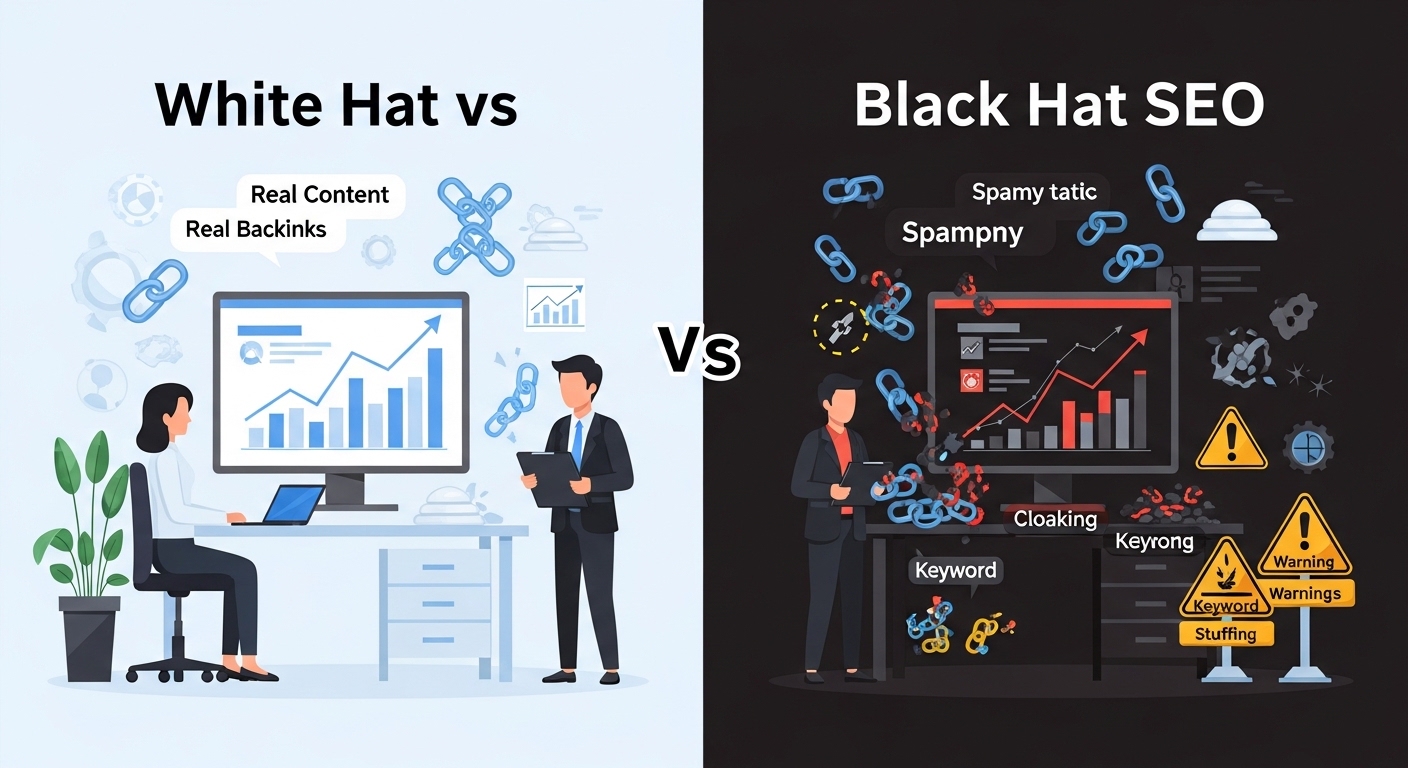
The terms white hat SEO and black hat SEO describe two completely different approaches to Search Engine Optimization. One works with Google’s Search Essentials guidelines. The other tries to trick the algorithm. The results of each approach look similar in the short term and wildly different in the long term.
This article explains what each approach actually involves, introduces the grey zone that most agency discussions ignore, and tells you exactly how to verify which approach an agency is using on your site before and after you hire them.
What Is White Hat SEO and What Does It Actually Look Like in Practice?
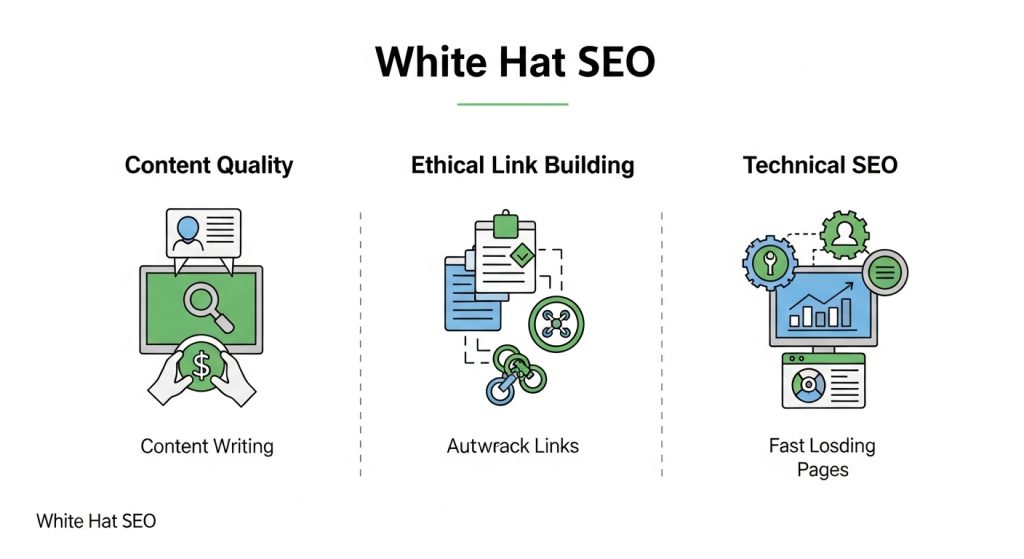
White hat SEO is the practice of improving a website’s position in organic search by following Google Search Essentials guidelines. The work is done for users first, search engines second. That sounds simple, but it covers a wide range of work.
Content Quality and Search Intent
White hat content is written to genuinely answer what a user is searching for. That means understanding search intent before writing: is the person looking for information, a product, a comparison, or a local service? The content answers their question clearly, at the right depth, using the language they would use.
Google’s Helpful Content system, introduced and expanded between 2022 and 2024, specifically targets pages written to rank rather than pages written to help. A white hat agency produces content that passes this test because it was written with users in mind from the start.
Ethical Link Building Through Real Outreach
Backlinks remain one of the strongest signals of a website’s authority in organic search. White hat link building earns those backlinks by creating content worth linking to and reaching out to relevant publications through editorial outreach.
A white hat agency can name specific publications they recently earned links from, explain the type of content used, and describe the outreach process. If an agency cannot do this when you ask, their link-building method is likely not editorial.
Technical SEO That Improves the User Experience
Technical SEO includes page load speed, Core Web Vitals performance, mobile usability, crawlability by search engine bots, structured data markup, and internal linking. White hat technical SEO improves the user experience as a direct outcome, not as a manipulation tactic.
What Is Black Hat SEO and Which Tactics Are Most Commonly Used Against Clients?
Black hat SEO refers to techniques that violate search engine guidelines, manipulate ranking signals artificially, and are designed to work around the algorithm rather than earn positions through quality.
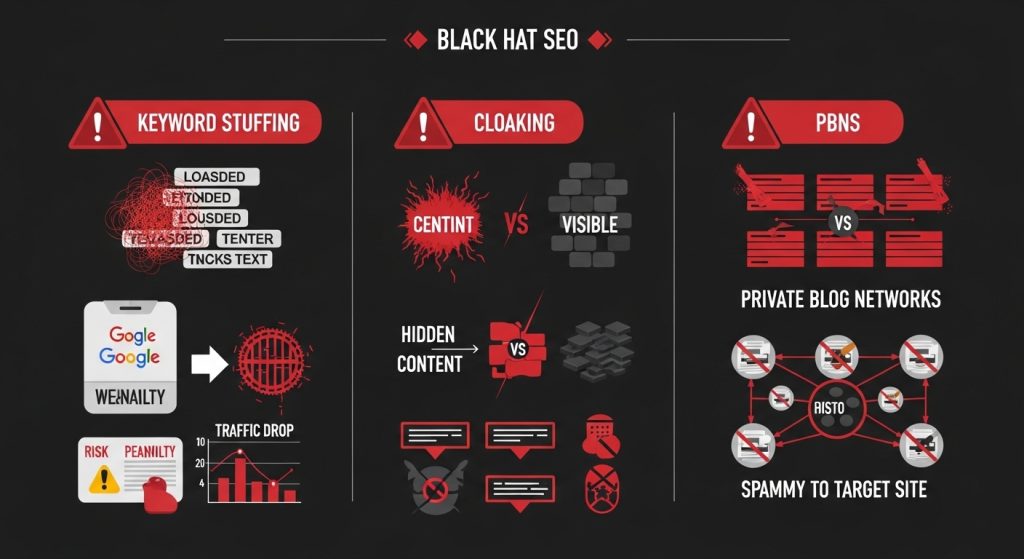
The risk is real and specific. Google issues manual actions through Google Search Console when they detect guideline violations. Recovery from a manual action typically takes 6 to 18 months and requires fixing every identified violation before submitting a reconsideration request.
Keyword Stuffing
Keyword stuffing is the practice of forcing keywords into a page at an unnatural density with the goal of manipulating search rankings. It makes content difficult to read and has been a direct violation of Google’s guidelines since the early 2000s.
It still appears in practice, often subtly. Footer text with location-based keyword lists, invisible lists of keyword variations, and overloaded meta tags are all forms of keyword stuffing that some agencies still use.
Cloaking
Cloaking means showing different content to Google’s search crawlers than what human users see when they visit the page. A common example is a page that shows search engines keyword-rich text while displaying users an image, a redirect, or completely different content.
Google uses sophisticated techniques to detect cloaking. When detected, the site typically receives a manual action that removes the affected pages from organic search results entirely.
Private Blog Networks (PBNs)
A Private Blog Network is a collection of websites, often built on expired domains with existing domain authority, used to build backlinks to a target site. The links look like editorial links to a crawler, but are controlled entirely by the same operator.
PBN usage is a direct link scheme violation under Google’s guidelines. Sites caught using PBN links face sitewide penalties, not just removal of the specific pages. Recovery requires identifying every PBN link, submitting a disavow file through Google Search Console or Bing Webmaster Tools, and waiting for a manual review.
Doorway Pages and Thin Content
Doorway pages are pages created specifically to rank for a particular keyword and then redirect users elsewhere, or funnel them to a page where the actual content has no genuine value. Thin content refers to pages with very little useful information designed primarily to appear in search results rather than serve users.
Negative SEO Targeting Competitors
Negative SEO is the practice of deliberately harming a competitor’s ranking by building spammy links pointing to their site, scraping and re-publishing their content to create duplication issues, or sending fake spam reports to Google. It is less common than the other tactics, but worth understanding because it means your site can be targeted even if you are doing everything correctly.
Monitoring your backlink profile in Ahrefs or Google Search Console regularly makes it possible to identify and disavow suspicious links before they cause damage.
Mass AI-Generated Content Without Expertise
This is a modern tactic that several older articles on this topic miss entirely. Publishing large volumes of AI-generated content without human editing, original expertise, or genuine insight is now treated by Google’s Helpful Content system as low-quality content. Sites that mass-produce AI content to fill keyword gaps, without any subject matter expertise behind it, have seen significant ranking drops in Google’s 2023 and 2024 core updates.
A white hat agency that uses AI as a tool for drafting has human experts review, edit, and add original insight before publishing. An agency that uses AI to produce and publish content at scale, unedited, is running a modern version of thin content spam.
What Is Grey Hat SEO and Why Is It More Dangerous Than It Looks?
Grey hat SEO is the category that most agency discussions ignore, and it is where a significant number of agencies actually operate.
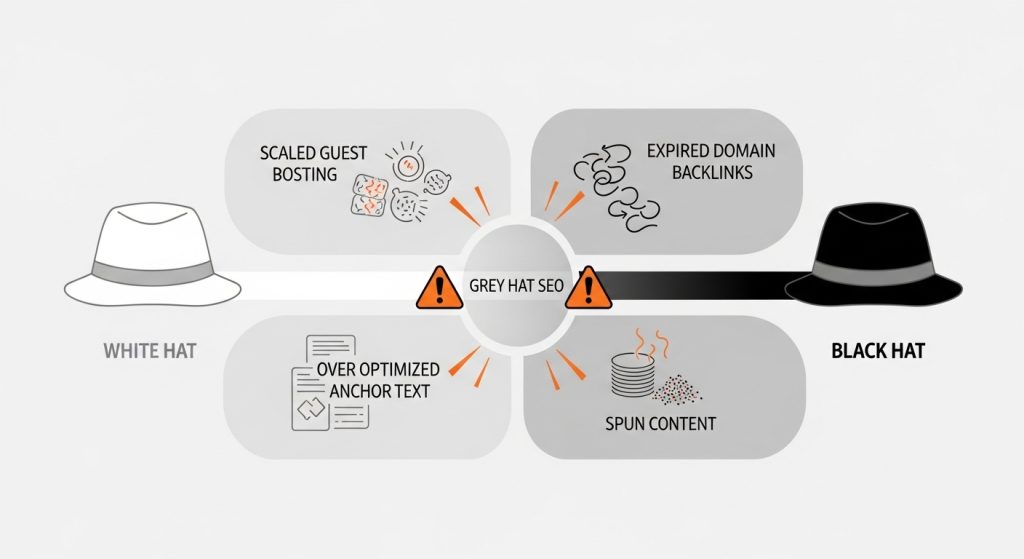
Grey hat tactics are not explicitly banned in Google’s guidelines, but are manipulative in intent and vulnerable to becoming violations as those guidelines evolve. The danger is that what works today may be penalized in the next core update, and the agency building on these tactics will point to the fact that they were not technically breaking any rules at the time.
Common grey hat tactics include:
- Guest posting at scale, where the primary purpose is link acquisition rather than genuine editorial contribution
- Building backlinks from websites on expired domains that have some historical authority but no real current relevance
- Over-optimized anchor text profiles, where the ratio of keyword-exact anchors is artificially high
- Article spinning or lightly rewriting existing content rather than producing original work
- Using structured data markup in ways that stretch the guidelines to earn rich results, the content does not genuinely merit
An agency using grey hat tactics will often describe their work as “advanced SEO” or “cutting-edge techniques.” The correct framing is: tactics that create risk you cannot fully quantify until an algorithm update rolls out.
White Hat vs Black Hat vs Grey Hat SEO: Full Comparison
| Factor | White Hat SEO | Grey Hat SEO | Black Hat SEO |
| Follows Google guidelines | Yes, fully | Partially | No |
| Link-building method | Editorial outreach, digital PR | Guest posting at scale, expired domains | PBNs, paid links, link farms |
| Content approach | Original, expert, user-first | Lightly rewritten or AI-generated | Spun, thin, or doorway pages |
| Cloaking | Never | No | Common |
| Risk of Google penalty | Very low | Moderate to high after updates | High to certain |
| Results timeline | 4 to 12 months of sustainable growth | Short-term with hidden risk | Fast then crashes |
| Recovery if penalized | Rarely needed | Possible but complex | 6 to 18 months minimum |
| PageRank and domain authority | Built through genuine authority | Built artificially | Manipulated temporarily |
The 2 Types of Google Penalties: What Each One Means for Your Site
Many business owners think “Google penalty” is a single thing. It is not. Understanding the difference helps you know what to check and what to expect if you have been using or have inherited a black hat approach.
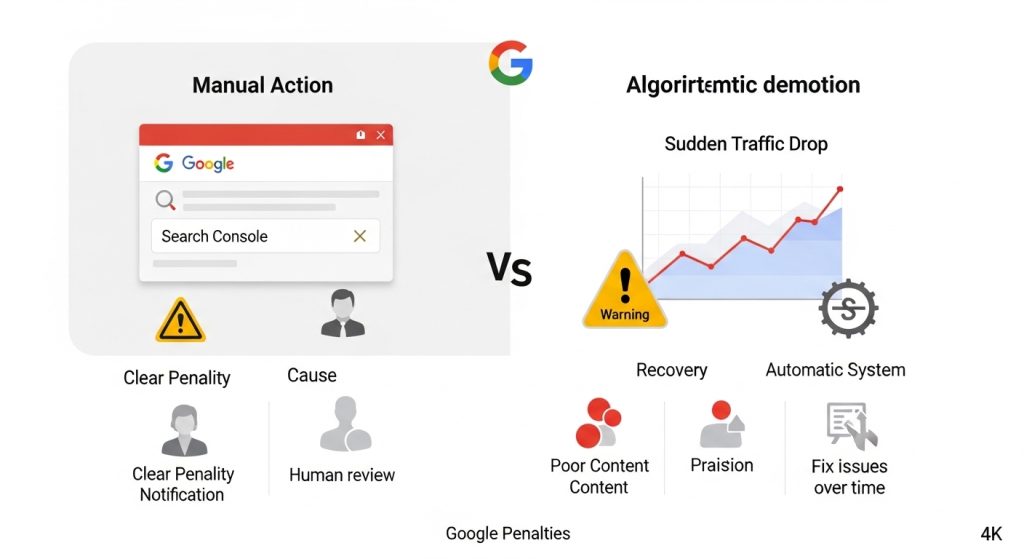
Manual Action Penalties
A manual action is issued by a human reviewer at Google after a violation is confirmed. It appears directly in Google Search Console under “Manual Actions.” The affected pages are either demoted significantly or removed from search results entirely.
Recovery requires fixing every identified violation, then submitting a reconsideration request explaining what was done. Google reviews the request, which can take several weeks. If approved, rankings begin to recover over the following months.
Typical causes: PBN links, paid links, cloaking, hidden text, spammy structured data.
Algorithmic Demotions
Algorithmic demotions do not appear in Google Search Console. There is no notification. Rankings simply drop, often sharply, during or after a core update or a specific system, as the Helpful Content system runs.
Recovery requires fixing the root cause: improving content quality, removing low-quality pages, and building genuine authority. Then you wait for the next time the relevant system processes your site, which has no fixed schedule.
Typical causes: Thin content, low-quality AI content, poor user experience signals, sudden spike in low-quality backlinks.
| Penalty Type | Visible in GSC? | Caused By | Recovery Process | Typical Timeline |
| Manual Action | Yes | PBNs, cloaking, paid links, hidden text | Fix violations, submit reconsideration | 3 to 12 months after approval |
| Algorithmic Demotion | No | Thin content, AI spam, poor UX | Fix root cause, wait for next system pass | 6 to 18 months |
| Negative SEO Damage | Sometimes | External spammy links built by others | Disavow file submission | 1 to 6 months |
How to Detect Black Hat Tactics on Your Own Site Right Now
This section is what no competitor article provides and what business owners most need. If you are already working with an agency or inheriting an existing site, you can check for these issues yourself.
Check Google Search Console for Manual Actions
Open Google Search Console, navigate to “Security and Manual Actions,” and select “Manual Actions.” If your site has a manual action, it will appear here with a description of what was found. Many business owners never check this section and do not know a penalty exists.
Audit Your Backlink Profile for Spam
Use Ahrefs or SEMrush to run a backlink audit on your domain. Filter by spam score or toxic score. Look for links from:
- Foreign-language sites with no relevance to your industry
- Sites with very low domain authority and no real content
- Sites with names like “best-links-2023.com” or similar patterns
- Large clusters of links acquired within a short timeframe
A sudden spike in low-quality backlinks is either the result of a black hat campaign run by your agency or a negative SEO attack by a competitor.
Check for Hidden Text and Cloaking
Use Screaming Frog’s SEO Spider to crawl your site. Look for text that uses very small font sizes, text colored identically to the page background, or elements with CSS display-none applied to entire text blocks. These are all hidden text techniques.
For cloaking detection, compare what you see when you visit a page normally against what Google’s cache shows. You can also use the URL Inspection tool in Google Search Console to see how Googlebot renders a specific page.
Review Your Content for AI Mass Production Signs
Open your most recently published pages. If they read like slightly reworded versions of each other, contain generic claims with no specific detail, or lack any original perspective, opinion, or evidence that a human expert contributed, the content may have been mass-produced.
5 Questions to Ask an SEO Agency to Verify Their Approach
These questions are designed specifically for evaluating an agency before signing. A white hat agency answers all of them specifically. A black hat or grey hat agency typically deflects, generalizes, or changes the subject.
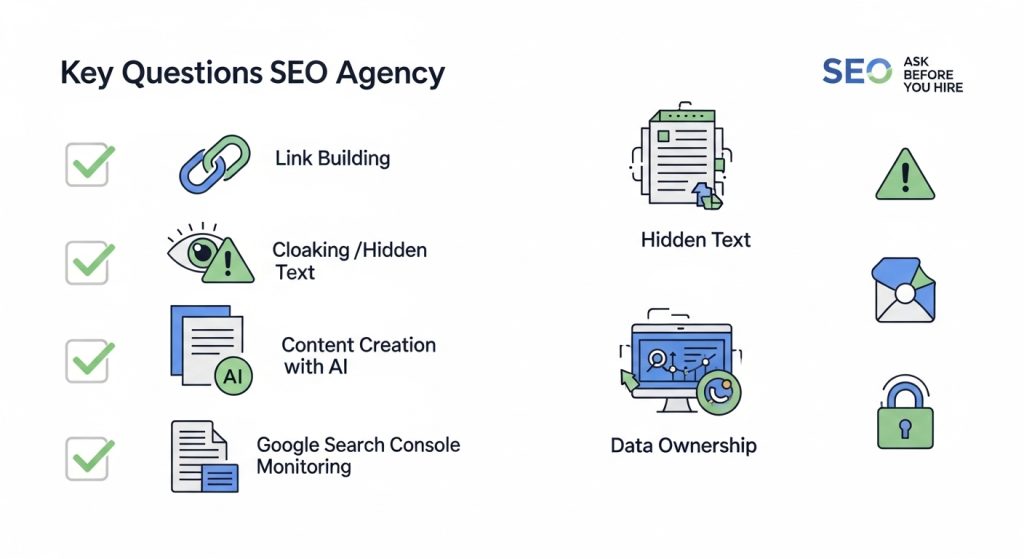
1. Can you name a publication you recently earned a link from for a client, and describe the content that earned it? This tests whether their link building is genuinely editorial. A white hat agency can name the site and the strategy. A PBN-reliant agency cannot.
2. Have you ever been asked to implement cloaking or hidden text, and how did you respond? The honest answer is either “no” or “yes, and we declined.” Any other answer is revealing.
3. How do you handle content creation, and what is the role of AI tools in your process? You are looking for: AI used for research or drafting, with human experts editing and adding original insight. You are not looking for: AI generates, we publish.
4. Do you monitor Google Search Console for manual actions on client accounts regularly? A white hat agency checks this monthly as part of standard reporting. If they are not monitoring it, they are not catching problems early.
5. What happens to my account and data access if I leave? This is not directly a white hat question but an ethical one. An agency that holds your Google Search Console access hostage when you try to leave is telling you everything about how they treat client relationships.
FAQ
What is the simplest way to explain the difference between white hat and black hat SEO?
White hat SEO earns rankings by creating genuine value for users and following Google’s guidelines. Black hat SEO manufactures rankings by manipulating signals in ways that violate those guidelines. White hat results last. Black hat results typically end with a penalty.
Can a website recover from a black hat SEO penalty?
Yes, but recovery takes time and resources. A manual action requires fixing every identified violation, submitting a reconsideration request, and waiting for Google’s review. Algorithmic demotions require fixing the underlying content or link quality issues and waiting for the next system pass. Both processes typically take 6 to 18 months.
Is grey hat SEO safe to use?
Grey hat tactics are not explicitly banned today, but carry real risk. Google’s guidelines evolve regularly, and tactics in the grey zone often become violations in the next core update. An agency using grey hat methods is building your site’s rankings on a foundation that can be pulled away without warning.
How do I know if my current agency is using black hat tactics?
Check the Manual Actions section of Google Search Console. Run a backlink audit using Ahrefs or SEMrush and look for patterns of low-quality or irrelevant links. Crawl your site with Screaming Frog and check for hidden text. Compare your page’s appearance in a normal browser against what Google Search Console’s URL Inspection tool renders.
What should white hat link building actually look like?
White hat link building involves identifying relevant publications in your industry, developing content or pitches that are genuinely useful to their readers, and earning a link through editorial decision by a real editor. The agency should be able to name specific publications they target, describe their outreach process, and show you real links earned in recent months.
Why do some agencies still use black hat SEO if the risks are so clear?
Because it works in the short term, and clients often cannot tell the difference between black hat gains and legitimate organic growth during the first few months. By the time a penalty arrives, the agency may have already moved on to the next client.
Conclusion
White hat and black hat SEO are not just different strategies. They produce different outcomes, carry different risks, and create entirely different long-term situations for your website.
The key insight most articles miss is that you need to verify, not just trust. An agency that claims to use white hat methods should be able to demonstrate it: name the publications they build links from, show you the Manual Actions section of your Google Search Console, and explain their content process in enough detail that you can evaluate it yourself.
Agencies listed on platforms like Top SEO Agencies provide verified profiles and independent reviews, which makes it easier to cross-check what an agency claims against what real clients report.
Browse verified SEO agencies at Top SEO Agencies